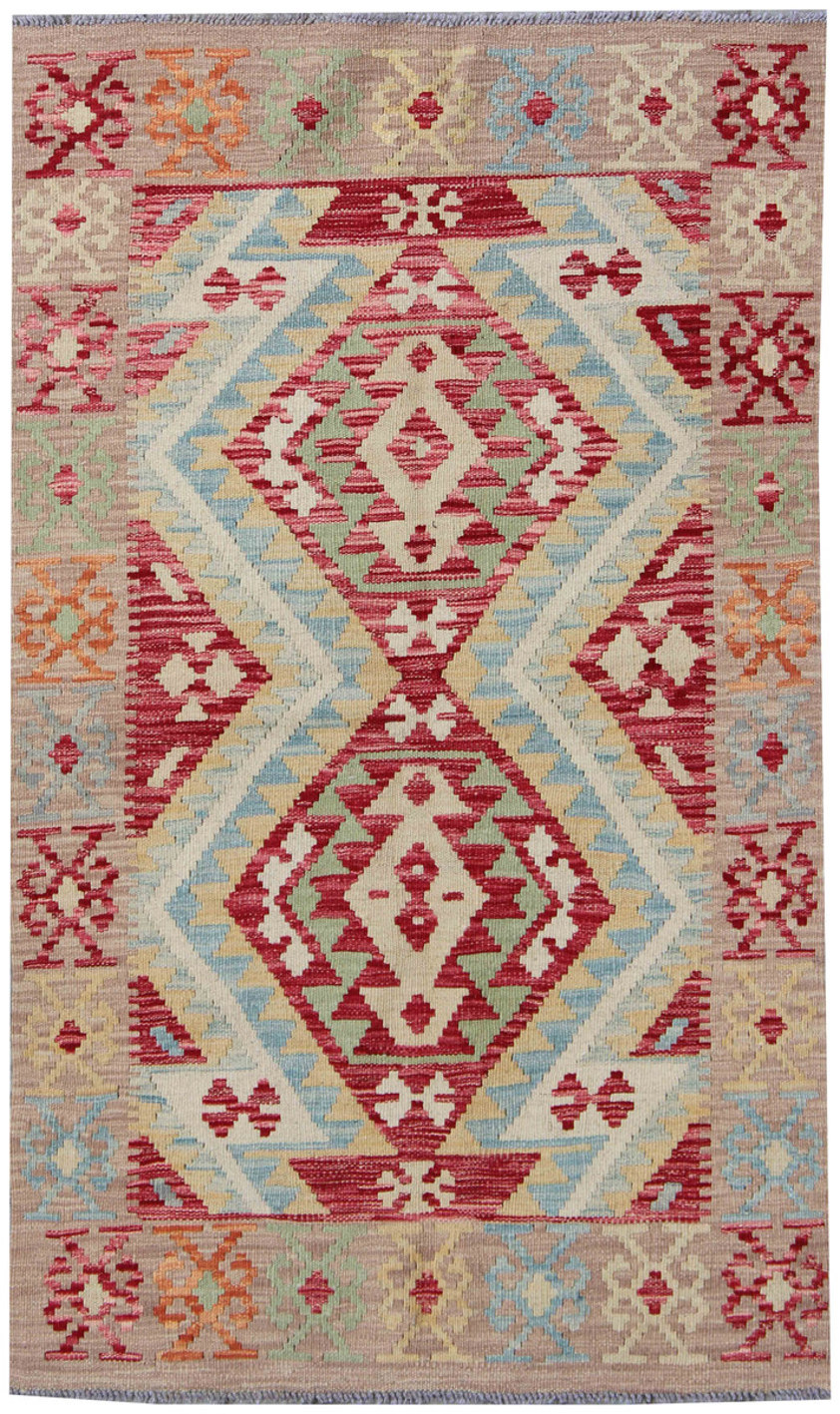
Pale blue zigzags trace the sides of the central design on this rug, framing two burgundy geometric centres. Cream angular lines, little red lozenges and soft green passages add detail within the field. The lighter end bands contain compact motifs in burgundy, peach, blue and muted yellow. Although the format is narrow, the design retains a clearly defined middle and an independent patterned frame.
This traditional Afghan kilim measures 157 × 92 cm, a size that could work beside a bed, a desk or a single armchair. Its blue and cream details would complement light painted furniture, while the burgundy could answer darker timber or a warm red fabric. The central zigzag movement is broad enough to remain readable from across a room.
Kilim designs belong to Afghanistan’s wider domestic textile culture, where angular motifs are adapted to rugs, bags and other household objects. Repetition supplies order, but colour and proportion determine how strongly the individual forms are read. In this example, cool blue sides give the red centres a particularly distinct setting. Fine horizontal variation brings a softer texture to the pale areas, preventing the light ground from appearing empty. The little end motifs are also important: they turn the eye across the width after the stronger vertical movement through the middle. Positioned with some clear floor around it, the rug’s compact arrangement can be appreciated in full.