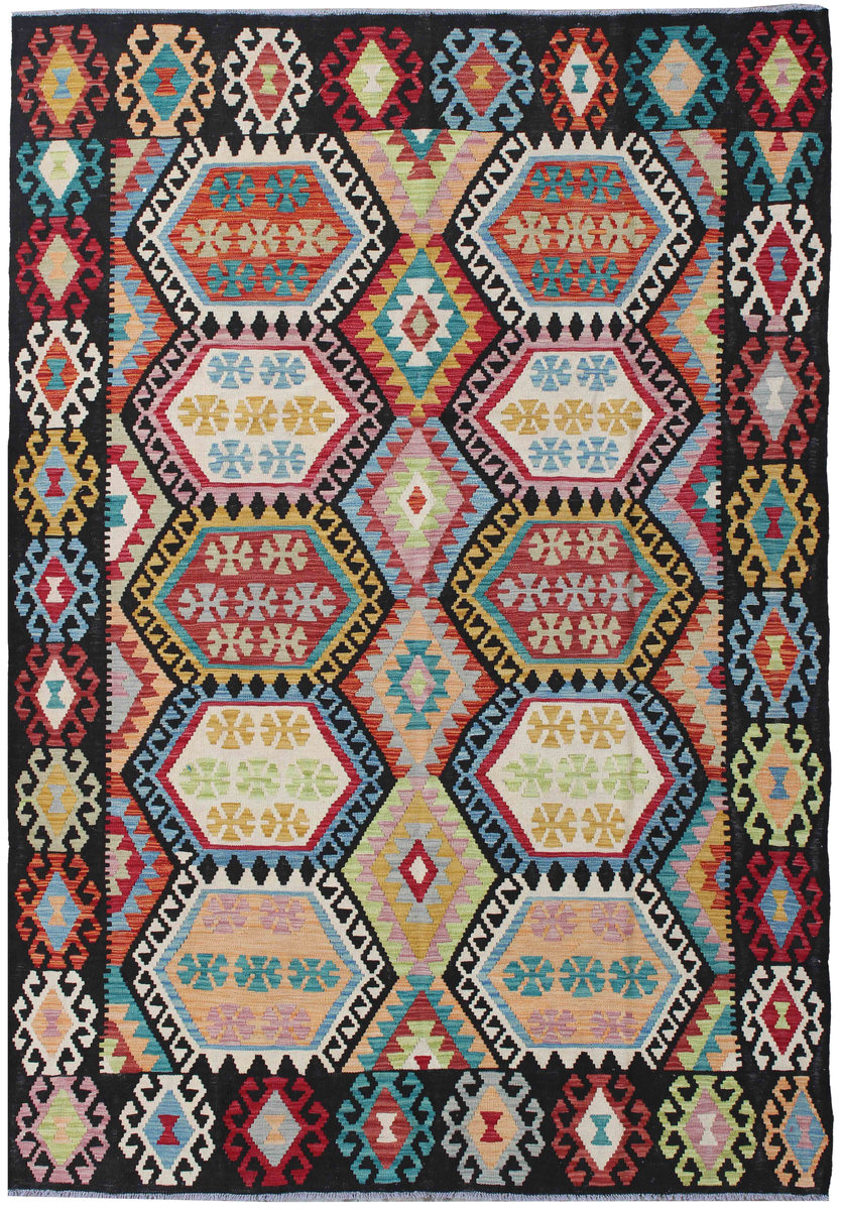
Five pairs of hexagons give this rug a strong vertical organisation. Cream hooks define their edges against the black ground, with red, blue, yellow and pale green changing through the interiors. Small diamonds fill the central gaps, while a procession of narrower medallions runs around the perimeter. There is a marked difference between the generous central compartments and the compact forms of the border. The individual hexagons are worth studying. Some contain rows of small linked motifs; others use lighter interiors to set off the finer drawing. The black intervals separate the colours clearly, preventing the full palette from becoming confused.
At 295 × 206 cm, this rug would have sufficient presence for a generous sitting room, particularly beside plain cream seating or a table in dark timber. Afghan kilims belong to a broad tradition of domestic weaving in which angular patterns appear on floor coverings and smaller furnishings. The same design elements can be enlarged, nested or repeated, so a shared vocabulary produces considerable variation between textiles.
Here the hooked hexagon supplies the main framework, with colour giving each compartment its own emphasis. The narrow border keeps a lively pattern visible even where furniture overlaps the middle. Red or blue could be repeated selectively in upholstery, though the rug already provides a complete colour scheme. Its fine horizontal tonal changes add a softer visual grain beneath the emphatic cream outlines.