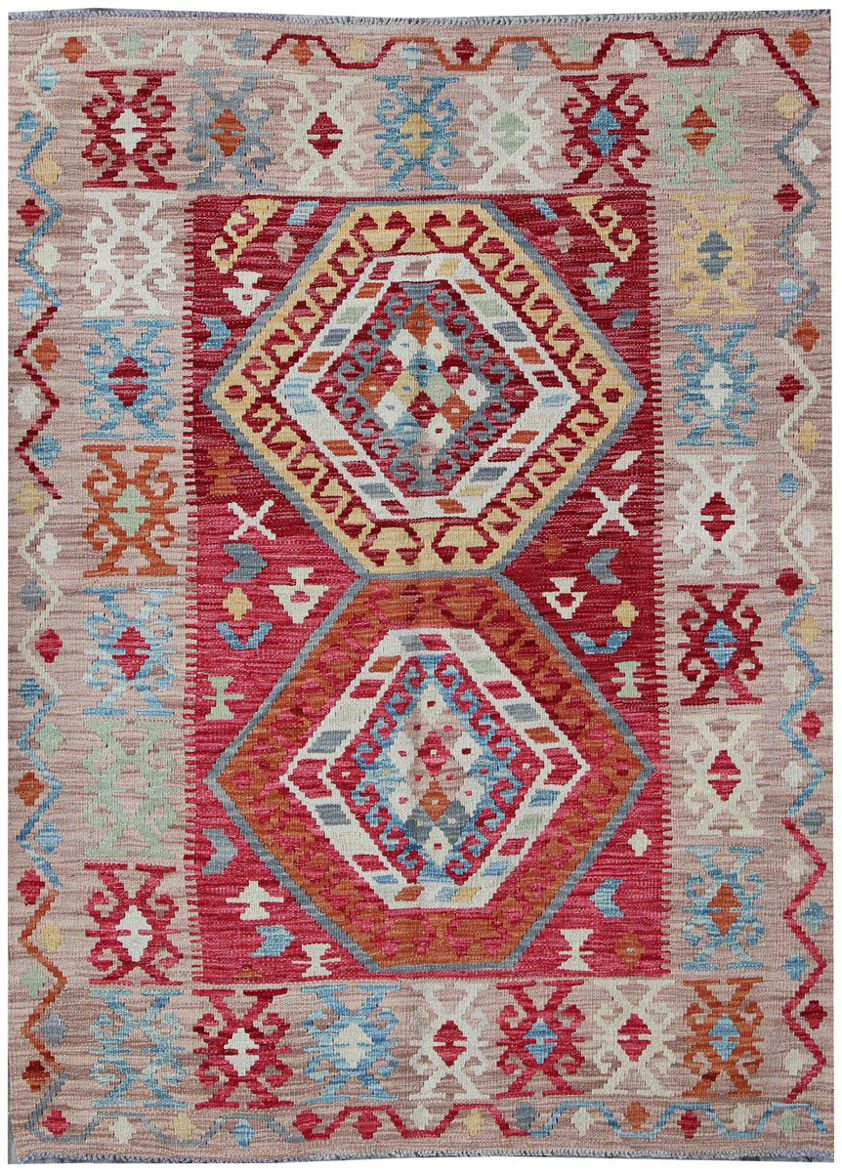
Two burgundy hexagons are set into a warm red panel on this rug. Their pale blue centres contain little groups of contrasting diamonds, with cream hooks surrounding the upper medallion and a quieter rust outline around the lower one. A broad light border introduces blue, pale yellow and burgundy geometric marks, while narrow angular lines define the outer edges. The two medallions are related without being identical, which gives the compact design a pleasingly varied emphasis. This traditional Afghan kilim measures 178 × 127 cm.
It would be well placed beside a desk or in a small sitting area, where the paired centres could be enjoyed without substantial furniture coverage. The pale framing would work with light walls; burgundy and blue provide stronger options for a nearby cushion or upholstered seat. Fine horizontal colour variations soften the field, adding a textile quality to the emphatic outlines. Afghan rugs form part of a much wider regional history of geometric household weaving. In kilims, repeated angular figures provide a flexible framework for changing colours and proportions.
A paired medallion arrangement concentrates that vocabulary into an easily read composition, while the border gives smaller motifs a separate role. In this rug, the combination of differently treated centres and a generously patterned frame is especially appealing: it offers a complete decorative scheme within a size that can find a place in many smaller rooms.