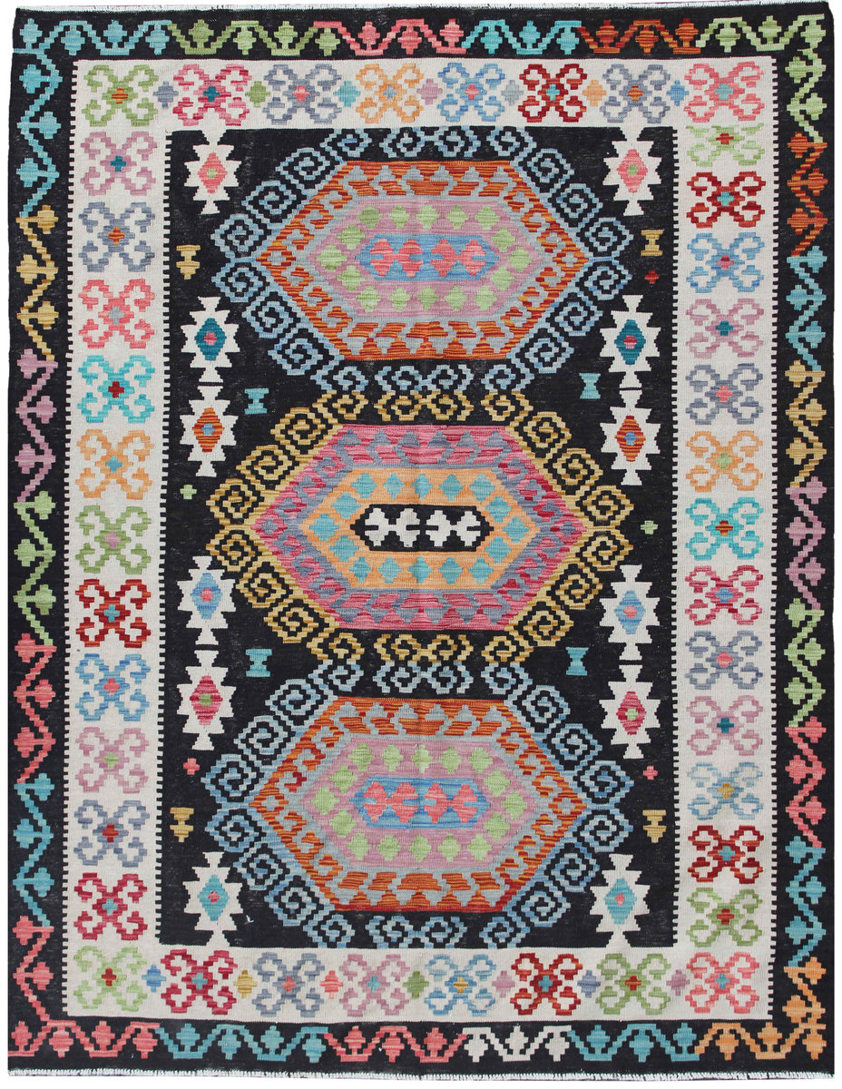
Three colourful hexagons stand against the black field of this traditional Afghan kilim rug. Pink, blue, green and orange fill their nested outlines, while cream scrolling angles trace a clear boundary around each medallion. Small geometric devices occupy the intervening black spaces. A wide pale border carries linked, multicoloured forms, enclosed by a darker band with an angular line. The contrast gives the whole arrangement immediate clarity. Each large hexagon has its own colour balance, and their smaller internal divisions offer considerable detail.
The pale border supplies a different rhythm from the stacked central ornaments, making the rug feel fully framed without diminishing the strong dark field. At 245 × 186 cm, this rug would bring a broad area of pattern to a compact sitting room or study. Plain cream seating would connect with the border, and dark timber would relate to the field. A small amount of pink, blue or orange elsewhere could pick up the individual medallions without repeating every colour in the composition.
Afghan kilims have an extensive repertoire of linked medallions, angular outlines and repeated border devices. Museum collections show related geometric forms used across rugs and other flatwoven furnishings. Here the familiar medallion-and-frame arrangement gains its distinctive character from the black ground and changing colours inside the three principal shapes, creating a design that remains clearly legible from across the room.