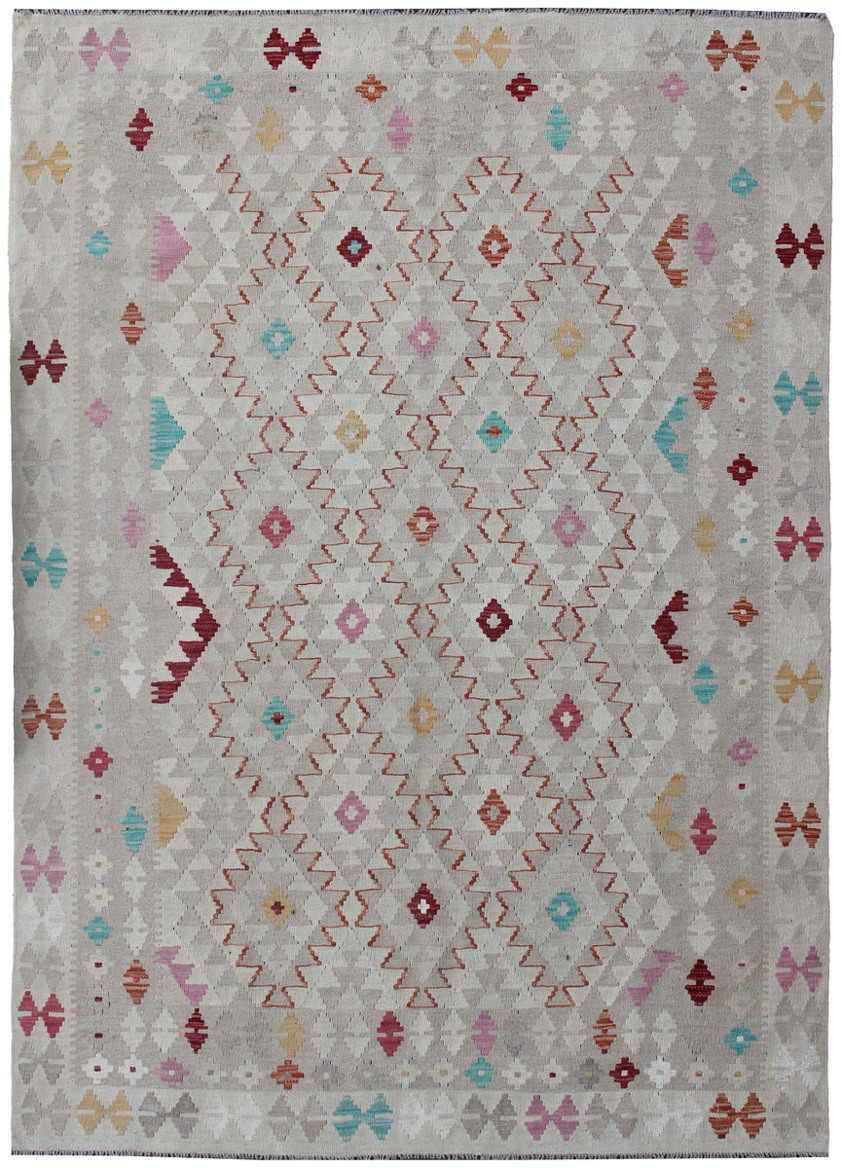
Fine stepped outlines form a group of diamonds across the ivory field of this traditional Afghan kilim rug. Rust-coloured lines define the larger shapes, while turquoise, pink, ochre and cream details provide small changes within and around them. Burgundy devices punctuate the paler areas, giving the eye a few stronger points to follow. A delicate border repeats tiny triangles and paired forms. The drawing is notably open. Much of the ivory remains visible, and the stepped outlines allow the diamonds to register without filling them with dark colour.
Soft grey and beige changes in the ground add a quiet visual texture. This makes the pattern more subtle than its varied palette might initially suggest. The geometric vocabulary of Afghan kilims includes both boldly filled medallions and lightly outlined forms. Repeated diamonds can organise a field even when the contrast is restrained, with smaller surrounding marks setting the rhythm between them.
This rug demonstrates that approach through slender lines, pastel accents and a finely scaled perimeter. At 240 × 174 cm, it could furnish a small sitting area or a bedroom where light fabrics and natural wood are already important. A darker table could give the furniture group a definite centre, leaving the rug to supply the finer detail. Turquoise or burgundy accessories would draw out selected accents, while plain cream upholstery would continue the openness of the background.