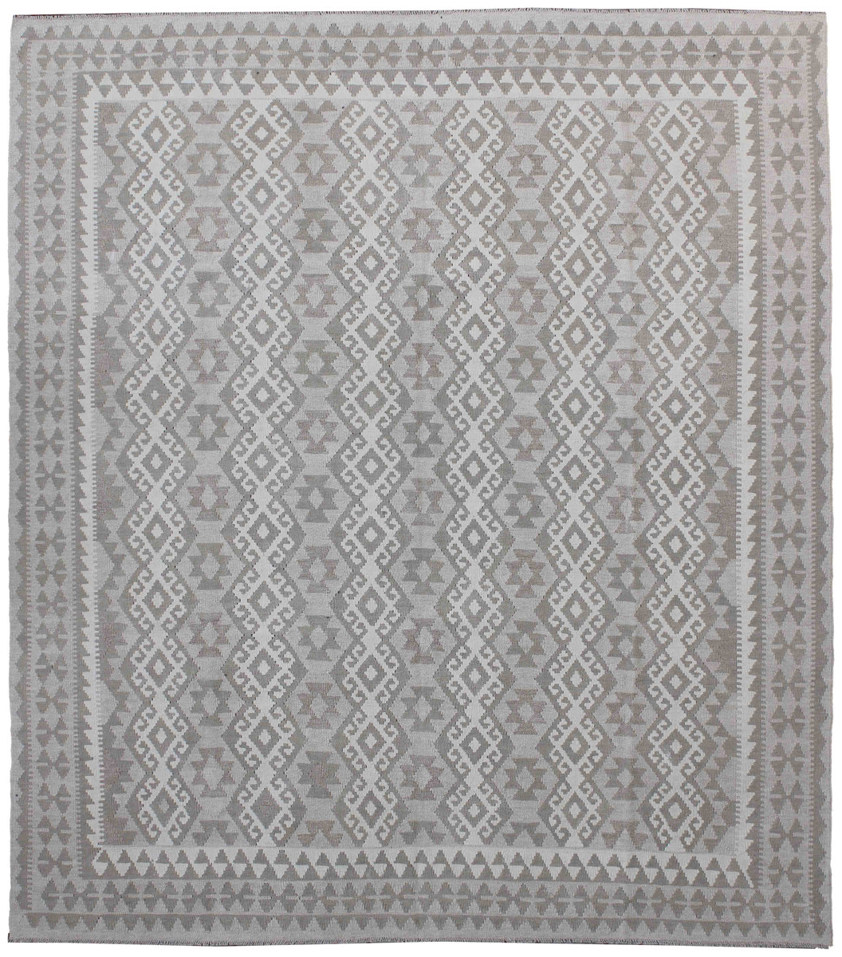
Interlocking hooked forms run in closely placed columns through this rug. Ivory outlines turn around small taupe centres, then extend towards the next compartment in the sequence. Little diamonds and stepped internal marks add a finer scale within the larger shapes. A broad frame of much smaller geometric devices contains the field, keeping the same restrained taupe-and-ivory palette. Some centres are darker than others, creating modest changes within the repeat. The finer border diamonds make those larger variations easier to read by providing a more even perimeter.
From a distance, the rug has the quiet effect of a pale geometric field; beside the seating, the repeated turns and small enclosed centres give a much more intricate view. Afghan kilims belong to an extensive regional flatweave tradition in which repeated shapes can be linked, enlarged or divided to create different compositions. Hooked contours are particularly useful for making one form appear to engage with its neighbour. Here, the field develops through vertical sequences, while the border supplies a closer enclosing rhythm around them.
The 283 × 249 cm format is notably broad. It could sit beneath a compact group of chairs, leaving portions of the pattern visible on more than one side. Plain ivory fabrics would answer the outlines, while warm grey upholstery could relate to the darker internal forms. A simply shaped table would leave the little hooks easy to distinguish around its base.