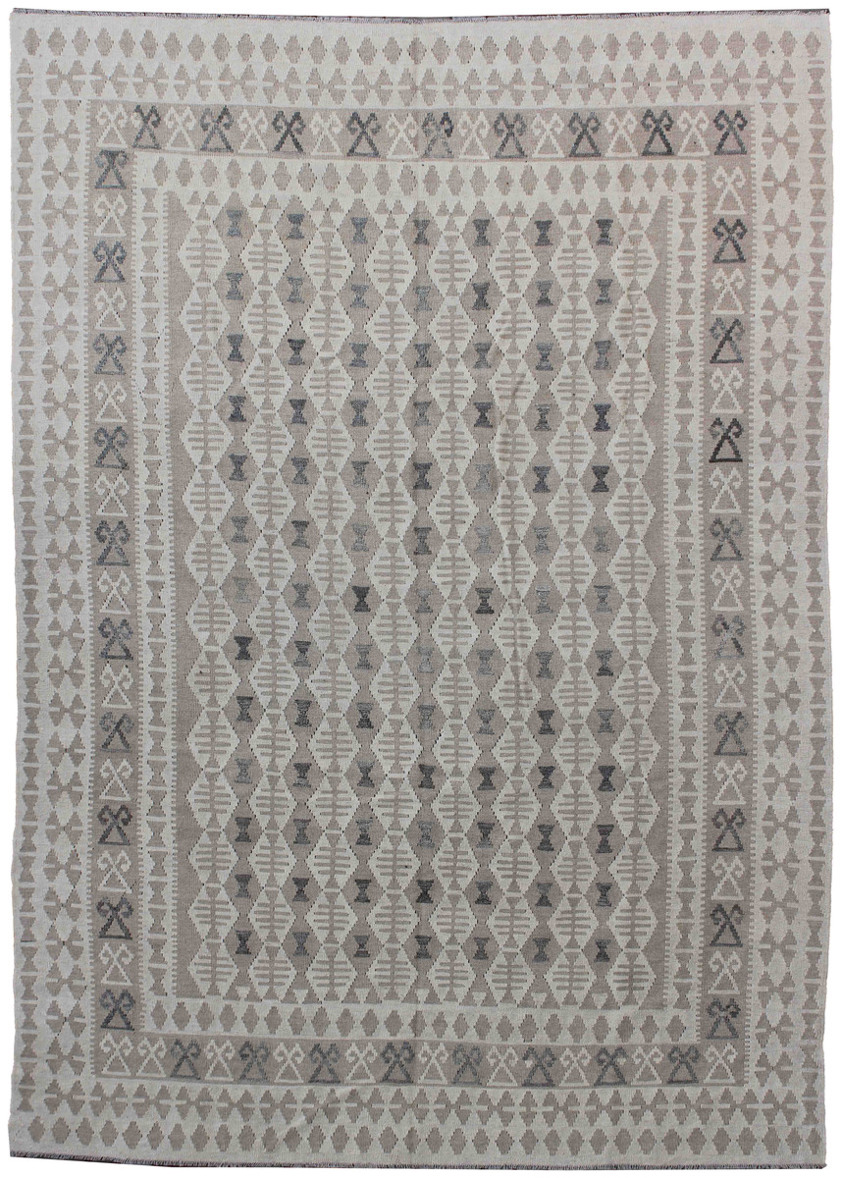
Fine columns of pointed shapes give this rug a close, lengthwise rhythm. Taupe, ivory and selected charcoal accents distinguish the elongated diamonds and their small horizontal divisions. A more emphatic angular band surrounds the field, with further rows of tiny lozenges near the perimeter. The darker marks are distributed sparingly, creating little interruptions within the otherwise pale repeat. Afghan kilims have an extensive geometric vocabulary, shared in broad terms with neighbouring flatweave traditions across Central and West Asia. Linked shapes, narrow bands and internal devices can all contribute to a composition without requiring a large central medallion.
This rug uses that distributed approach, making the change of scale between field columns and border one of its clearest decorative features. Measuring 340 × 243 cm, it could provide a lightly patterned floor beneath a generous seating arrangement. Cream upholstery would continue the pale ground, and charcoal furniture could answer the stronger small accents. Warm grey paintwork would relate to the taupe passages.
The repeated design remains apparent around the furniture even if part of the middle is covered. At close range, the little horizontal marks inside each pointed shape add texture to the drawing. The enclosing angular band has broader, more open devices, while the outer diamond rows return to a finer scale. These successive changes keep the framing distinct without making it substantially heavier in colour than the intricate inner field.