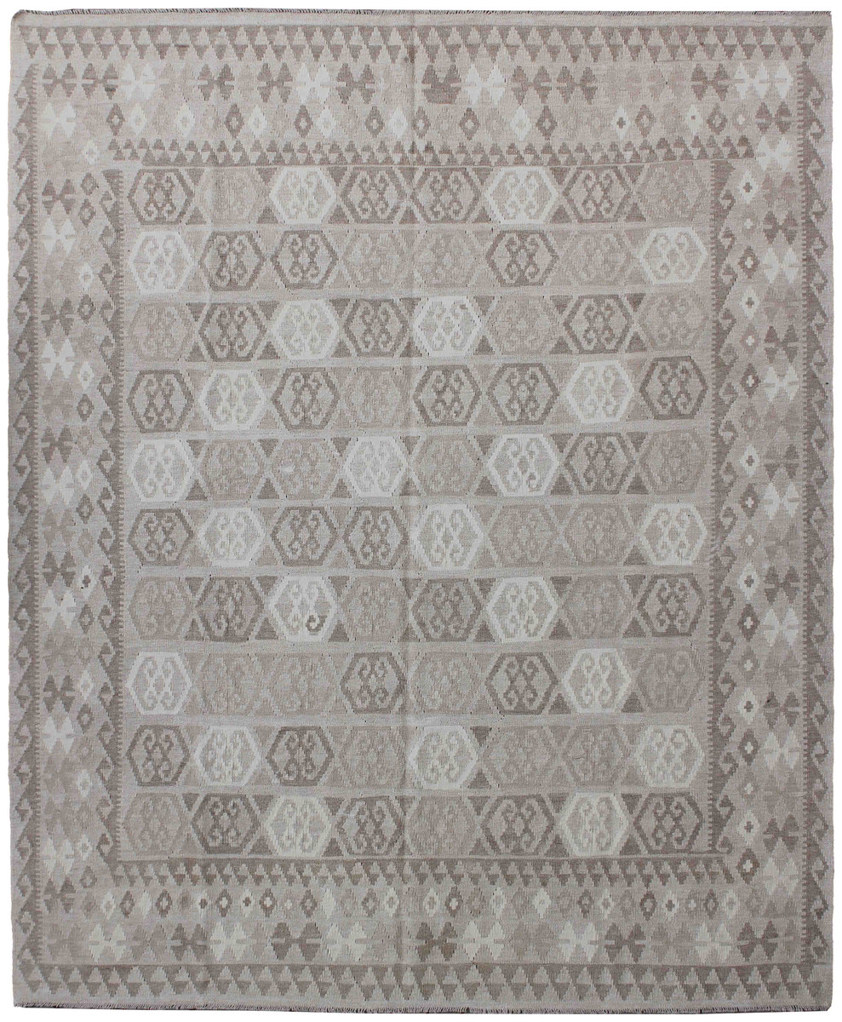
Linked hexagonal rows create a clear lattice across this rug. Ivory outlines enclose small curled angular devices on a taupe ground, with alternate compartments varying in strength. A broad border repeats much smaller diamonds and pointed forms. The change of scale gives the inner lattice a definite boundary without introducing a sharply different palette. The 290 × 240 cm dimensions offer a broad rectangle for a group of chairs or a generous bedroom setting. Plain ivory furniture would refer to the outlines, while warm grey fabrics could connect with the darker compartments.
The repeat continues across the whole field, allowing sections of the middle to be covered while the principal design remains apparent elsewhere. Afghan kilims form part of an extensive regional history of flatwoven textiles. Geometric frameworks can be developed through linked cells, small internal motifs and enclosing bands, with colour changes altering the apparent weight of individual units. This rug makes that variety visible within a restrained range of taupe, grey and cream.
The lattice is regular, but its tonal differences prevent every cell from looking identical. Pale hexagons can be followed across a row, then interrupted by a darker compartment whose little internal curl is more conspicuous. The border has a finer, more continuous rhythm. Near seating, the eye moves between those small edge diamonds and the larger linked cells, while the overall impression remains quiet enough to sit beside plain fabrics and simply shaped furniture.