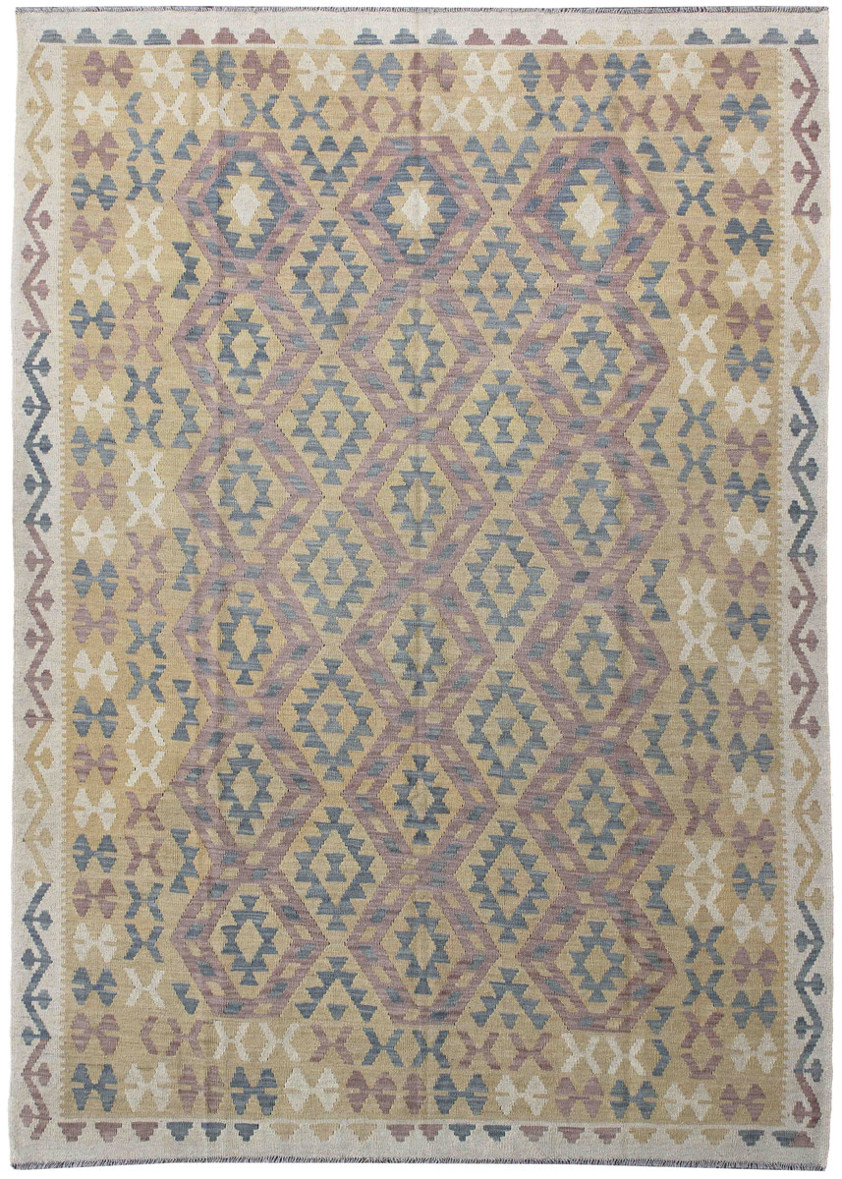
Two linked columns of hexagonal forms organise the middle of this rug. Their stepped blue-grey outlines enclose smaller cream and yellow diamonds, with additional angular devices occupying the narrow spaces between the columns. The surrounding ground is pale yellow, and rows of small lozenges and chevrons create a lighter framework around the larger shapes. At 287 × 204 cm, the rug has enough breadth for its paired columns to be appreciated around a modest seating arrangement. Plain cream upholstery would answer the light centres, while a grey-blue chair could pick up the darker outlines.
Its warmer yellow field could also sit comfortably beside natural timber, particularly where the furniture leaves a clear stretch of the length visible. The geometric vocabulary belongs within the broad history of Afghan kilims and their neighbouring flatweave traditions. Linked shapes give a field its structure, while different centres and surrounding devices allow a repeated outline to carry considerable variation.
Historically, flatwoven textiles served numerous domestic purposes across the region, from floor coverings to other household furnishings. Here, the small inner diamonds do much of the detailed work. Some are clearly outlined, others are separated mainly by a shift of colour. The side bands have a finer pace, with repeated angular marks leading towards the corners. Pale intervals keep the whole composition relatively light, even where several layers of stepped outline meet around the larger hexagonal compartments.