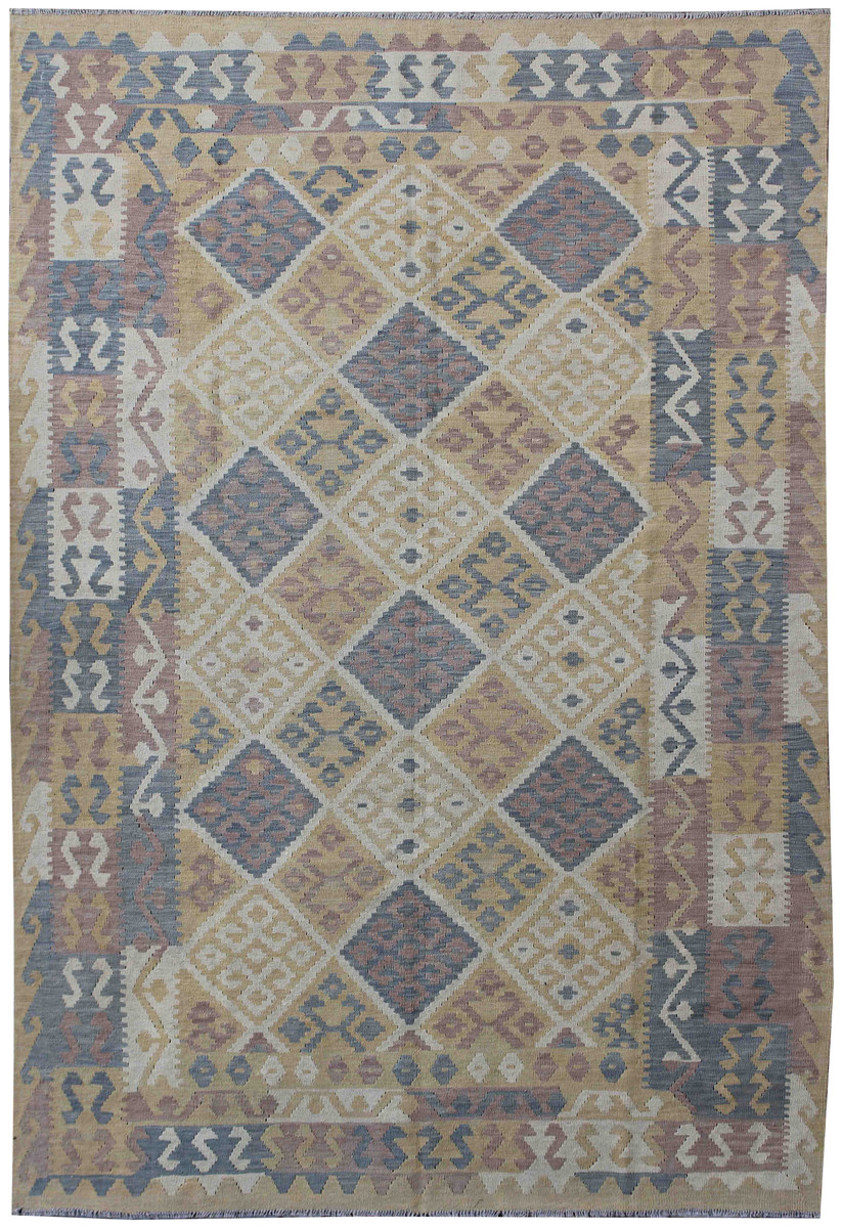
Diagonal rows of diamonds give this rug a strong movement through its long field. Darker blue compartments alternate with pale cream and ochre examples, each containing smaller geometric details. Fine stepped lines keep the neighbouring shapes separate. A broad border surrounds the interior with little hooked forms and repeated angular devices, changing colour in larger blocks along the sides. Kilim weaving belongs to an extensive flatweave tradition across West and Central Asia.
Afghanistan’s geometric examples form part of that wider textile culture, in which diamonds, repeated bands and small internal ornaments can be combined in many arrangements. This rug gives those familiar elements a particular organisation through its slanting rows and the different scale of pattern in the enclosing frame. The colours are quiet rather than stark. Pale yellow and taupe sit beside softened blue-grey, with small warmer marks inside selected diamonds. Measuring 287 × 197 cm, this rug could provide a patterned base for a sitting area with cream upholstery.
Warm wood would relate to the ochre notes, while blue fabrics could continue the cooler compartments. The border is worth leaving visible. Its hooked figures have a more compact rhythm than the broader field shapes, and its changing blocks prevent the frame from appearing uniformly dark. Near a chair, the small centres and stepped edges offer a finer view of a design that reads more broadly as a diagonal arrangement of pale and blue diamonds.