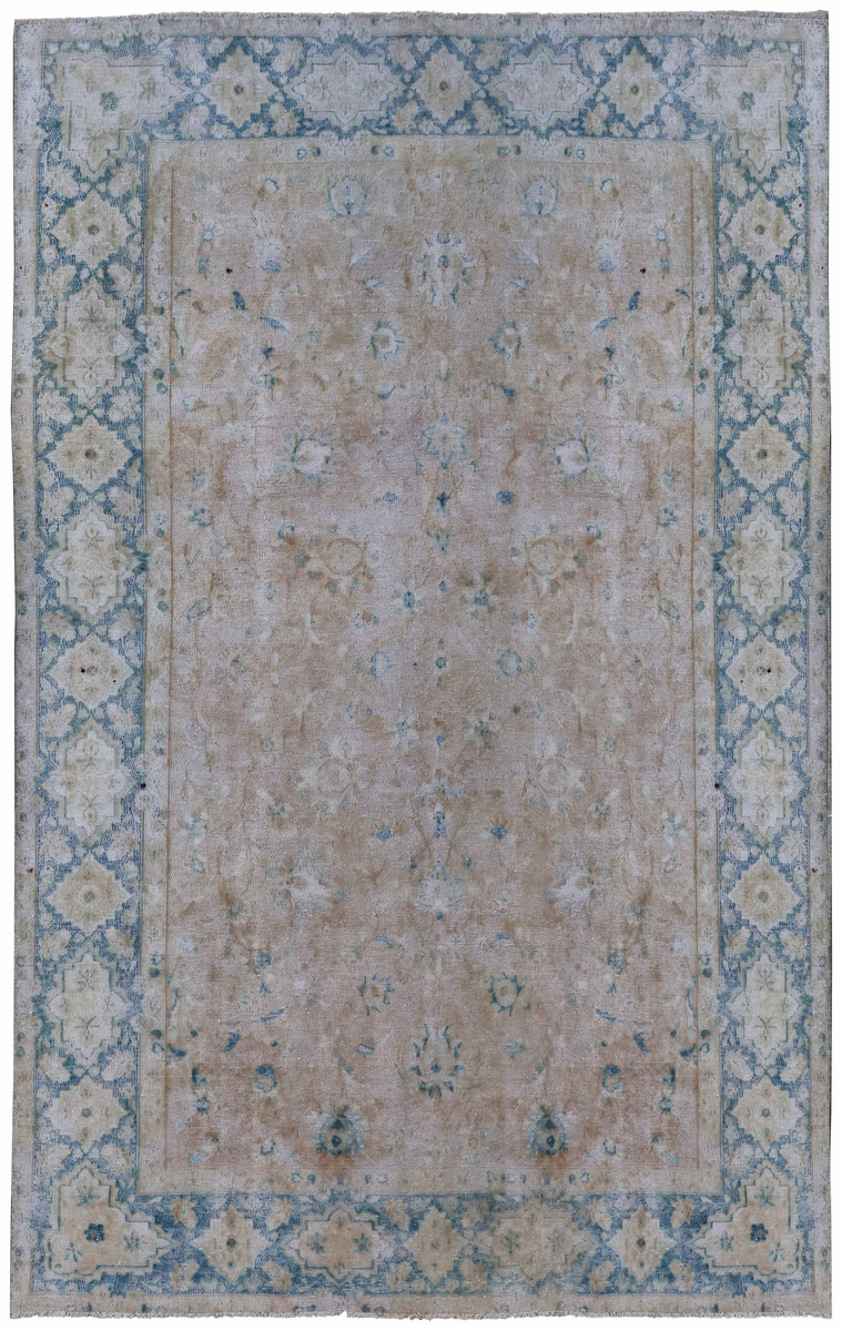
The ornament in this rug is distributed gently across a pale peach-toned field. Blue floral forms and smaller supporting figures appear at intervals, with enough light space between them to keep the surface open. Their outlines vary in visibility as the ground changes tone. The effect is more dispersed than a composition governed by one dark centre, giving the eye several quiet points of interest. The surrounding blue frame contains larger light-coloured motifs, some approaching diamond or rounded shapes. These broad units provide an effective contrast to the finer detail inside.
Narrow separating lines give the border a clear structure, while the restrained colour differences keep it connected with the field. The photographed surface has a softly layered character, combining delicate drawing with broader passages of pale colour. Persian carpet ornament often uses related floral elements at different scales. Smaller figures can animate a field, while enlarged forms in the borders establish a firm edge and a separate rhythm.
That relationship remains visible in this vintage Persian overdyed rug. It is useful design history for understanding the composition, without treating a recurring motif as proof of one particular weaving centre. It could soften a room containing angular furniture or dark timber, especially where a strongly contrasting carpet would feel too insistent. Cream seating would extend the lighter areas, and muted blue cushions could connect with the frame. Let the pale field remain partly uncovered to preserve its spacious arrangement of ornament.