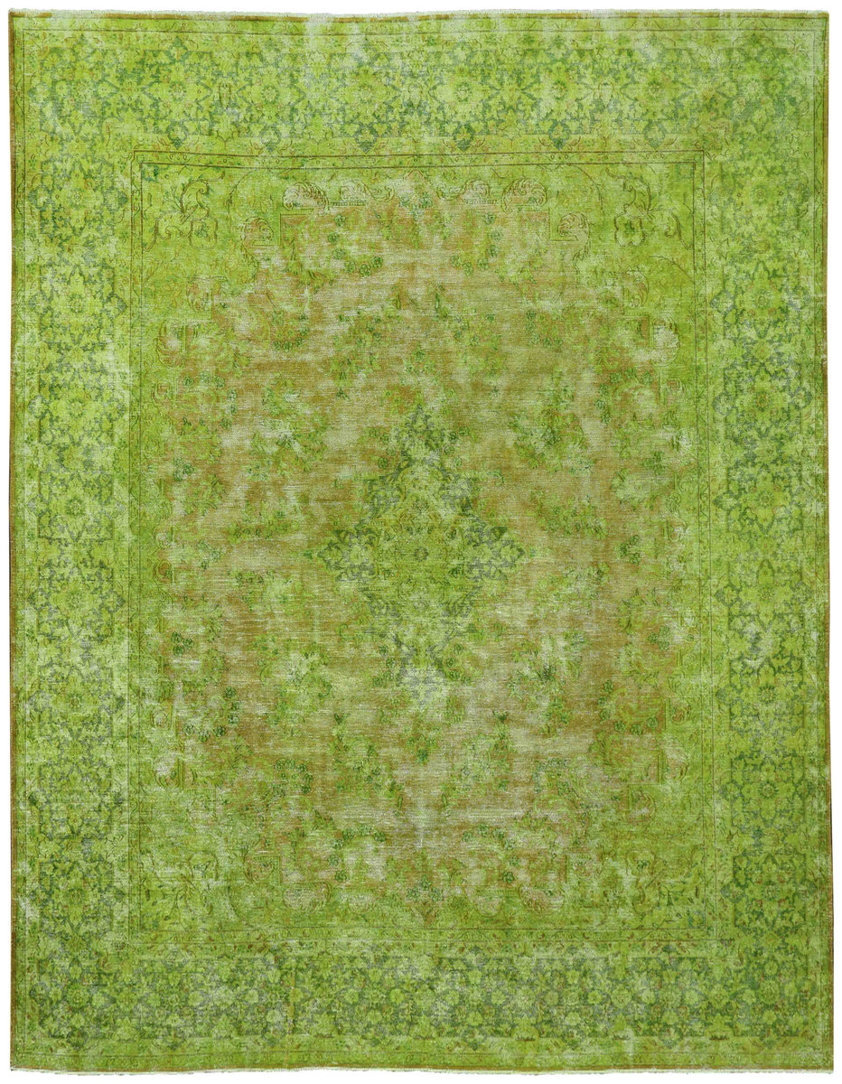
Lime colour is the strongest feature of this vintage Persian overdyed rug. Fine darker floral traces remain visible across the middle, with pale yellow-green passages creating local changes of contrast. Several rectangular lines mark the border structure, and the surrounding bands contain more closely arranged ornament. The centre is less sharply defined than the frame. Horizontal tonal shifts and small pale interruptions add depth to the broad green surface, allowing the underlying pattern to become clearer gradually when the rug is viewed at close range rather than through a strong isolated medallion.
Persian carpet design includes continuous floral fields as well as prominent medallion compositions. In both, enclosing bands provide a structural boundary and can carry a more compact repeat than the middle. Here, that organisation remains visible beneath the vivid colour. Overdyeing changes the relationship between ground and ornament; the product name does not identify the original town of manufacture or a precise date. The historical discussion therefore concerns the visible field-and-border arrangement, without treating the present lime palette as evidence of regional origin.
This rug could introduce a bright focus beside cream upholstery, pale stone or simple dark wood furniture. Yellow-green accessories would echo its lighter passages, while plain walls would give the colour room. Leaving the middle open would reveal the tonal shifts. Exposed margins would retain the fine enclosing lines and show the quieter floral detail that continues around the perimeter.