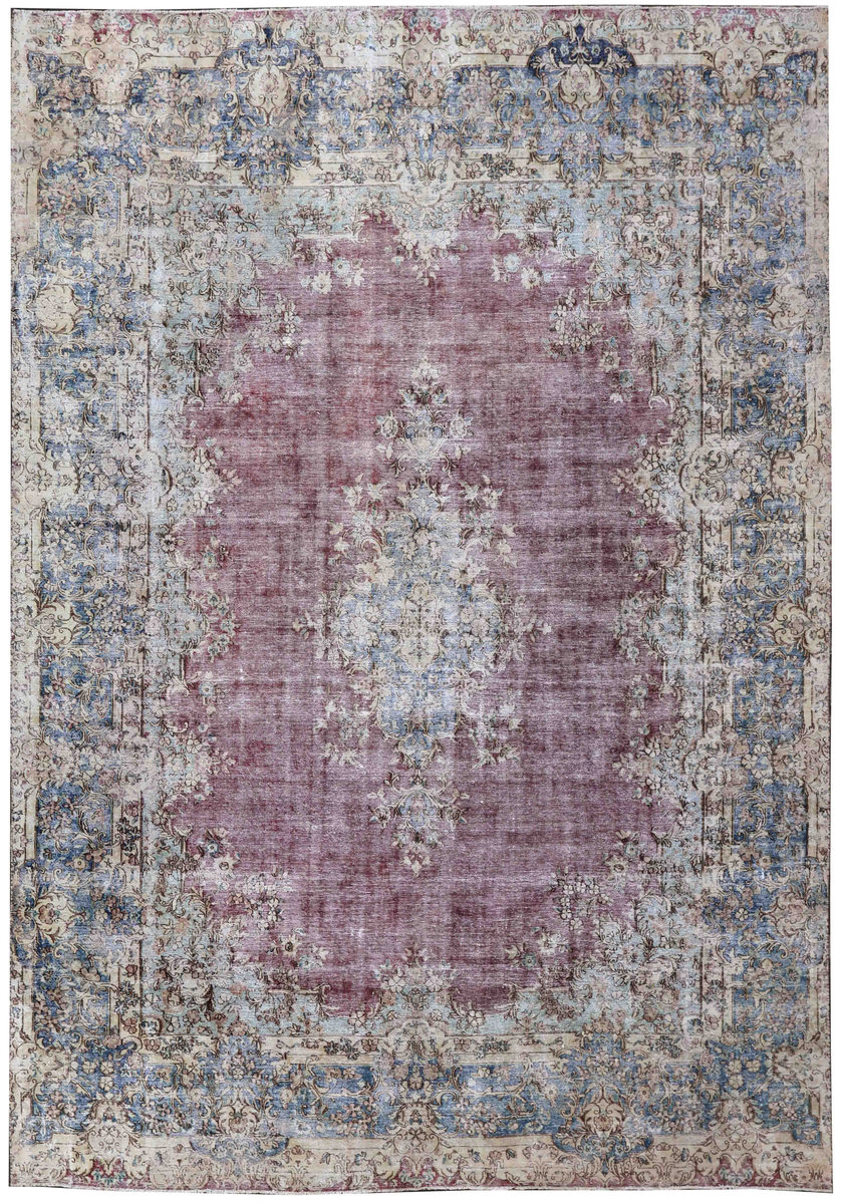
A rose-toned field sits within broad blue-toned borders on this vintage Persian overdyed rug. Fine floral details spread through the middle, with paler branches and small blossoms becoming clearer in some areas than others. The surrounding bands contain denser scrolling ornament in cream, blue-grey and muted warm shades. Narrow lines separate the main border from its inner and outer companions. The contrast is one of pattern density as well as colour: the centre feels more open, while the frame provides a richer continuous sequence of smaller floral units around it. The distinction between field and border is fundamental to many Persian carpet compositions.
A principal outer band can carry a more compact decorative rhythm than the larger forms inside, with narrower guard bands clarifying their boundaries. This rug retains that layered organisation beneath its softened rose and blue palette. The overdyed designation indicates a colour treatment rather than a particular weaving town, and it does not establish a precise date or workshop. The visible floral framework provides the appropriate historical context without transferring unsupported details from other regional examples.
This rug could accompany plain cream seating or a warm wooden table. Muted rose fabrics would connect with the field, while blue-grey ceramics could echo the border. An open arrangement would preserve the lighter middle. Leaving a generous portion of the outer bands visible would best show their denser drawing and maintain the complete relationship between the central area and its surrounding floral frame.