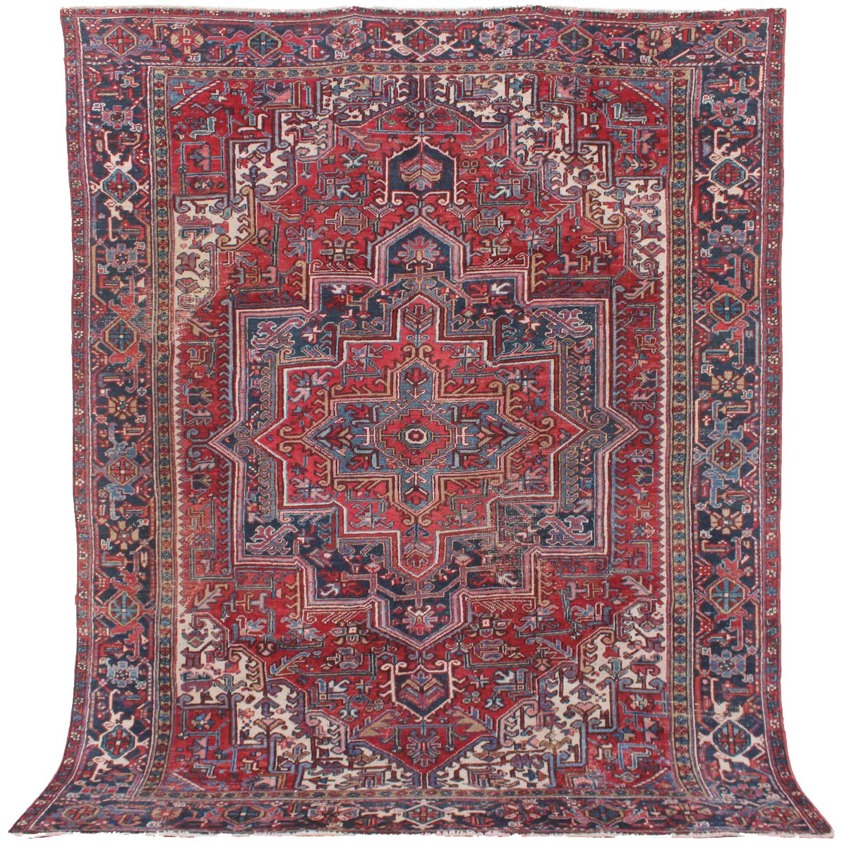
Successive stepped outlines build a large medallion through the middle of this rug. Red and dark blue alternate around a smaller star-like centre, with cream marks giving selected edges extra definition. Angular flowers, hooked leaves and little geometric devices fill the surrounding field. A broad patterned border closes the composition with a finer, more regular repeat. The drawing has several distinct scales.
The broad medallion is clear from a distance, but tiny internal marks and short linking lines become more noticeable nearby. Cream corner passages break up the red field, and narrow bands distinguish the border from the middle. Leaving a section beside the furniture exposed would show how those compact angular ornaments surround the much larger central structure without losing their individual outlines. The 309 × 248 cm dimensions give the medallion a broad setting. It could provide a definite centre for a group of plain chairs, with cream fabrics referring to the light outlines and blue upholstery connecting with the darker areas.
A low table would leave substantial parts of the stepped surround visible beyond its sides. Angular medallions form an important strand within Persian carpet design. A large central ornament can retain a floral vocabulary while translating its outlines into points, steps and compact geometric units. The field and border then introduce related details at smaller sizes. This vintage Persian overdyed rug uses that layered organisation with a particularly strong red-and-blue contrast.