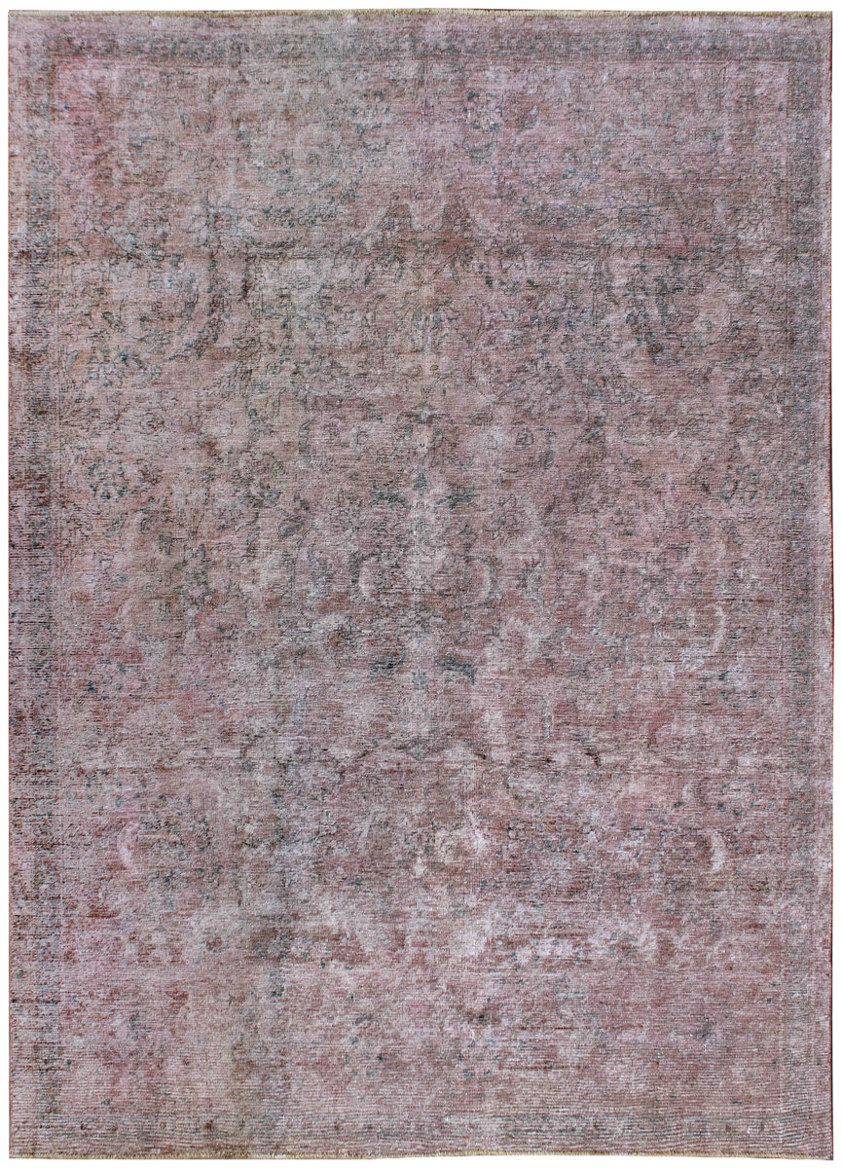
Rose colour spreads across this rug in pale and deeper passages, with grey-brown ornament appearing through it. A softly defined medallion occupies the middle. Curved forms, small flowers and traces of an enclosing framework can be followed around the centre, while the broad outer bands remain close in colour to the field. The pattern is visible without making every part equally prominent. Persian carpets often organise floral detail around a principal centre, then introduce a different repeat within the surrounding borders.
That relationship between central ornament and frame can remain legible even when their colours are closely related. On this vintage overdyed rug, the separate areas are distinguished through changes of outline and tone rather than strong divisions between contrasting grounds. Its 327 × 232 cm proportions would suit a generous bedroom arrangement or a sitting area in plain pale fabrics. Rose upholstery would continue the warmer colour, while grey-brown wood could refer to the darker drawing.
A table with a simple outline would leave the softly visible medallion as the main patterned reference. The surface has considerable horizontal variation, making some little details clearer than others. Near the edge, faint botanical forms gather into more regular bands. The middle is broader and less evenly defined, giving a closer view a gradual movement between pale intervals and stronger ornamental marks. Its decorative appeal lies in that restrained balance of warm colour and partly revealed floral structure.