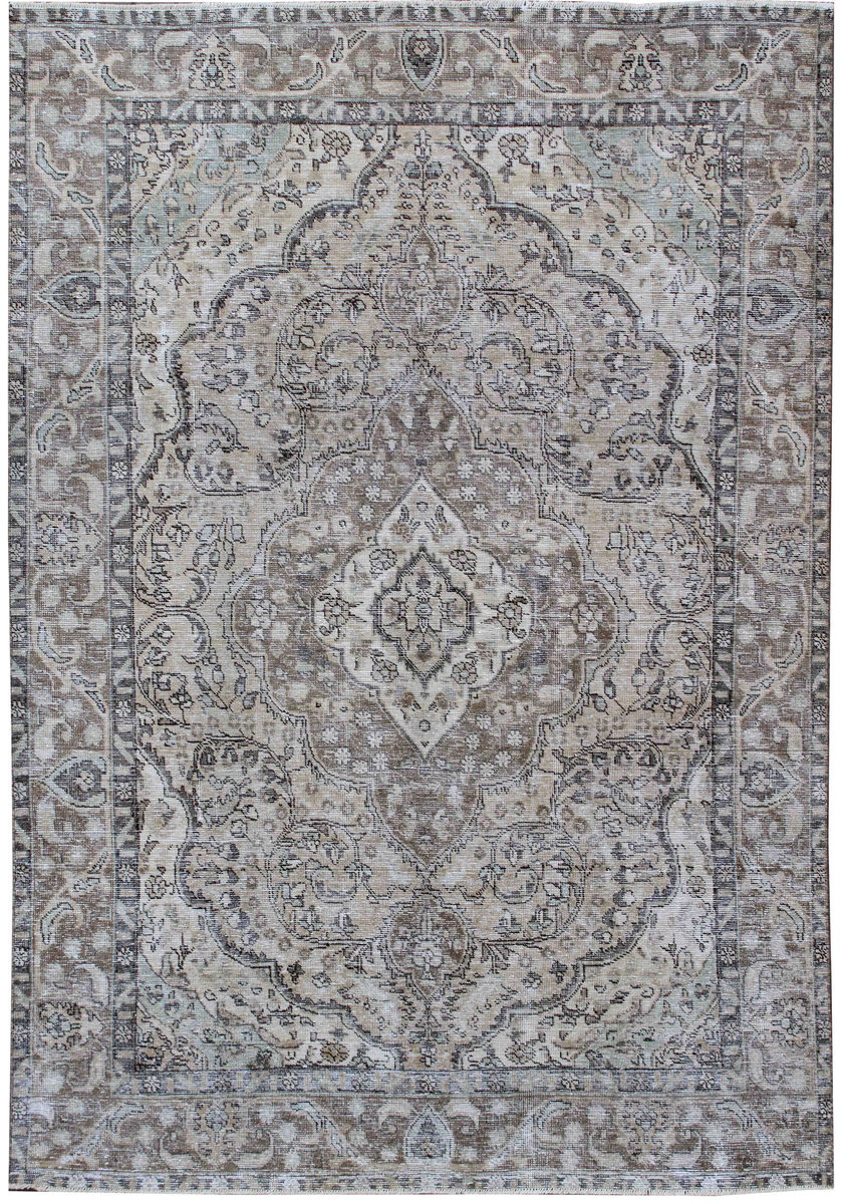
Dark curving lines rise around the pale diamond centre of this rug, defining a much broader ornamental surround. Cream and taupe floral forms fill the intervening spaces, joined by fine grey-blue outlines. The upper and lower parts of the field narrow into pointed arrangements, while the enclosing border carries larger repeated blossoms between several slender bands. A medallion does not need to be the only decorative scale in a Persian carpet. Small flowers, branching stems and larger surrounding contours can each give a field another level of organisation.
Such combinations have a long place in Persian design history. This vintage overdyed example makes the distinction particularly clear: a compact diamond inside a far more expansive curving framework, followed by a separate patterned perimeter. Measuring 285 × 197 cm, this rug would sit comfortably with a modest seating group.
Cream fabrics could answer the light passages, while grey or taupe upholstery would connect with the ornamental outlines. A table with a relatively open base would let the relationship between the central diamond and its surrounding curves remain visible. The pattern is dense, but the pale ground repeatedly breaks through it. Some leaves are reduced to fine lines, while larger flowers have fuller rounded shapes. Those changes stop the centre from reading as a single solid mass. Along the border, the repeated botanical ornaments supply a more even pace around the much less regular interior drawing.