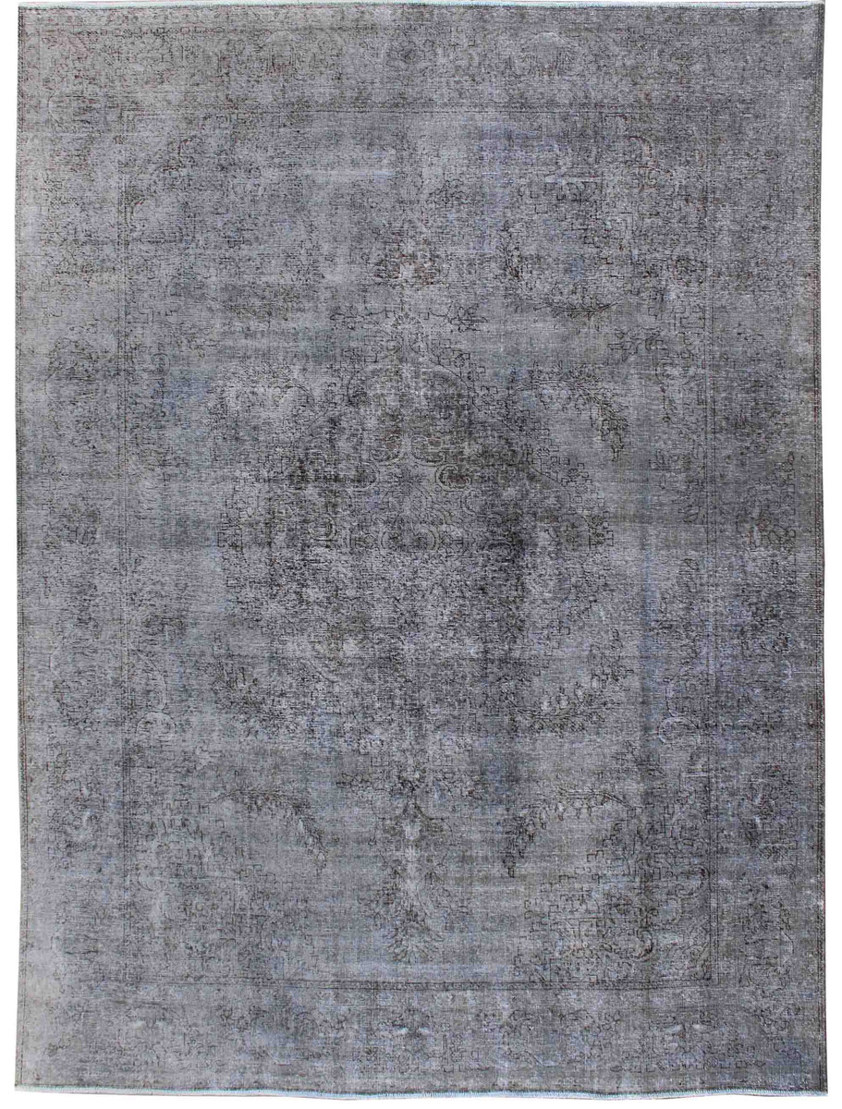
Grey tones bring the field and border of this rug into a closely related palette. Underlying floral ornament remains visible in places, with a faint central arrangement and darker marks towards the perimeter. Some areas are comparatively light, while others gather into deeper slate-grey patches. The effect is softly mottled, with the design emerging intermittently through the dominant colour. The large 385 × 295 cm format would be particularly useful in a room that needs a substantial rug without a strong colour accent.
It could sit beneath a generous sofa group or provide a quiet base for a library or study. Warm timber, leather and varied book spines would have a calm surrounding surface, while the finer ornament would add interest nearer the floor. Persian carpet design has historically combined clearly ordered fields with ornamental frames, often using flowers and scrolling foliage to connect their different sections. Overdying can bring those elements into a more unified palette, changing the emphasis from separate colours to tonal relationships.
This vintage rug retains the underlying decorative structure while allowing grey to become its most immediate feature. The surface should be appreciated at more than one distance. From further away, its changes of grey establish a broad area; closer inspection reveals the smaller traces of pattern. Pale upholstery could lighten the setting, and darker metal details could echo the deeper marks. An uncluttered area around the edge would let the subtle perimeter remain distinguishable from the central field.