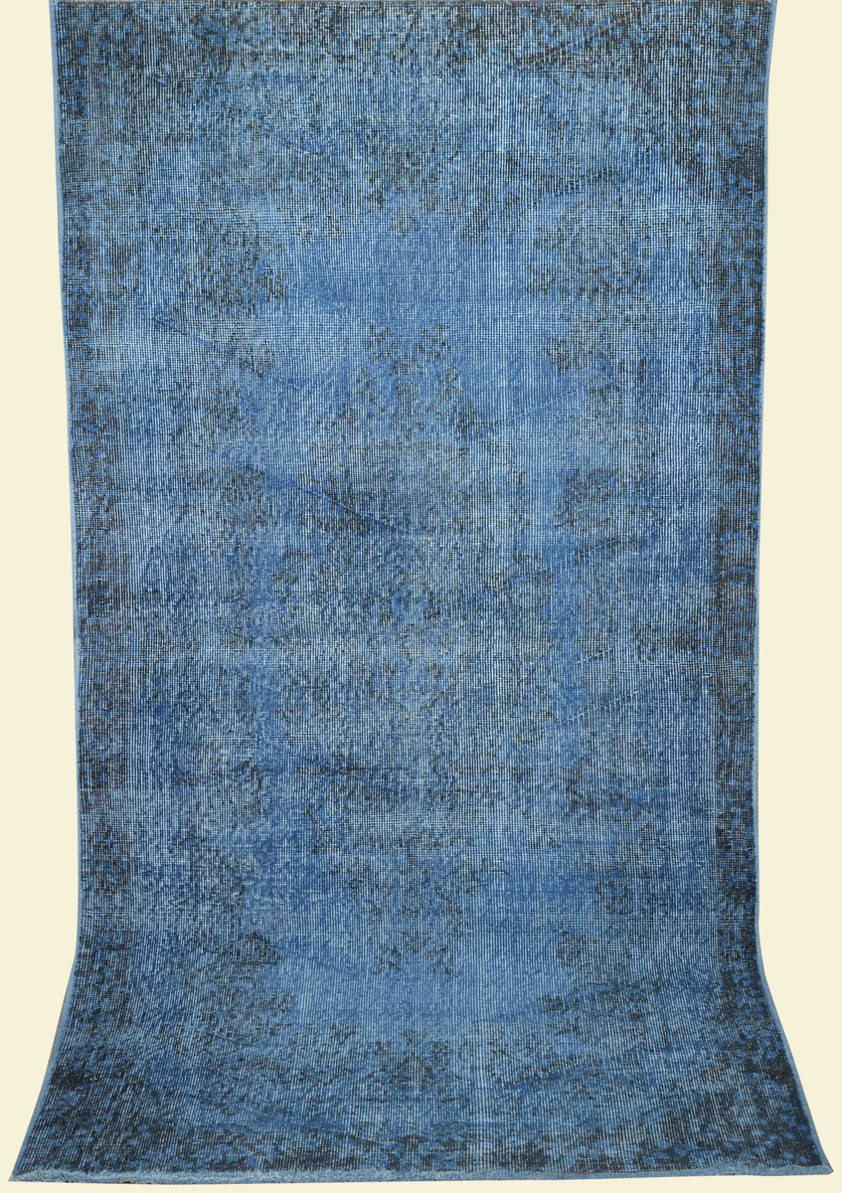
Colour takes the lead in this rug. Blue extends across almost the entire surface, shifting between lighter passages and deeper, inkier areas. The underlying floral pattern remains visible, but it is subdued: a faint central ornament gathers among small curling details, and the outer border appears as a darker tonal band. Changes in clarity give the surface a softly mottled, almost clouded appearance. At 206 × 113 cm, this rug would introduce blue to a compact area without requiring a large patterned composition to be displayed in full. It could sit beside a bed, in front of a small sofa or within a reading corner.
The more continuous colouring would remain effective even where furniture covers part of the underlying ornament. Persian carpets have historically employed both centralised and repeating floral layouts, with borders providing an enclosing structure. In an overdyed rug such as this, the older drawing may be read chiefly through tonal variation rather than separate colours. The relationship between field and frame is still present, although the strong blue gives the whole piece a more unified visual character.
Cream fabrics would provide a light contrast, while walnut or other warm timber would temper the cooler colour. Dark blue cushions could connect with the deeper passages without matching the entire rug exactly. Its appeal lies in the way the pattern surfaces gradually, so a simple surrounding scheme would leave those quieter details easier to appreciate.