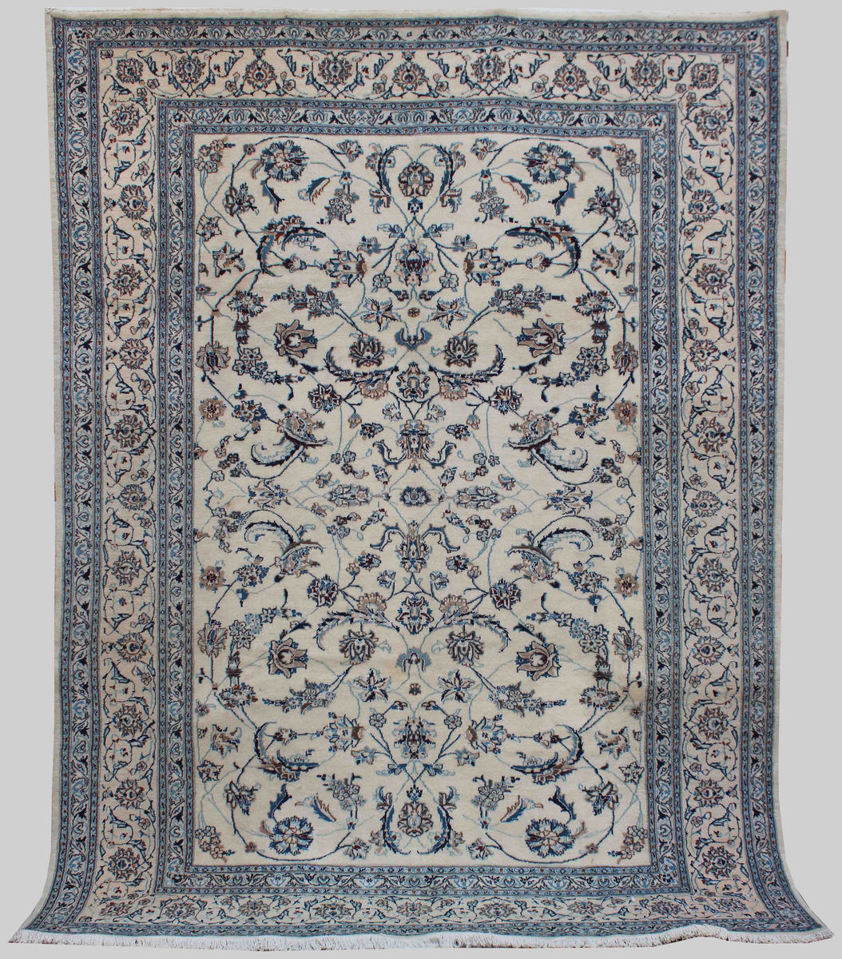
An ivory ground makes the blue floral drawing on this rug particularly legible. Separate palmette-like flowers and curling leaves are joined by fine stems, with darker blue outlines distinguishing the more expansive forms. Smaller blossoms provide closer detail between them. The surrounding border carries a denser botanical sequence, divided from the field by several delicate bands. The field has a different rhythm from the frame. Its larger flowers are individually placed with pale intervals between them, while the border offers a closer succession of leaves and blossoms.
Some internal details are very fine, making a nearby view more intricate than the broad blue-and-ivory impression. An exposed long side would show both scales together, from the airy field stems to the more continuous botanical pattern at the perimeter. Nain is a weaving centre in central Iran, near Isfahan, whose carpet industry developed alongside the changes in the region’s earlier textile trades.
Its rugs are closely associated with the finely organised floral vocabulary of Persian workshop design. This vintage example gives that ornament a light setting, allowing the stems and individual flower outlines to remain visible against an extensive ivory ground. At 331 × 247 cm, this rug could sit beneath a generous seating group in pale fabrics. Blue upholstery would answer the stronger floral marks, while cream furniture would continue the light field. A table with a simple shape would leave the surrounding scrolls as a detailed margin around its base.