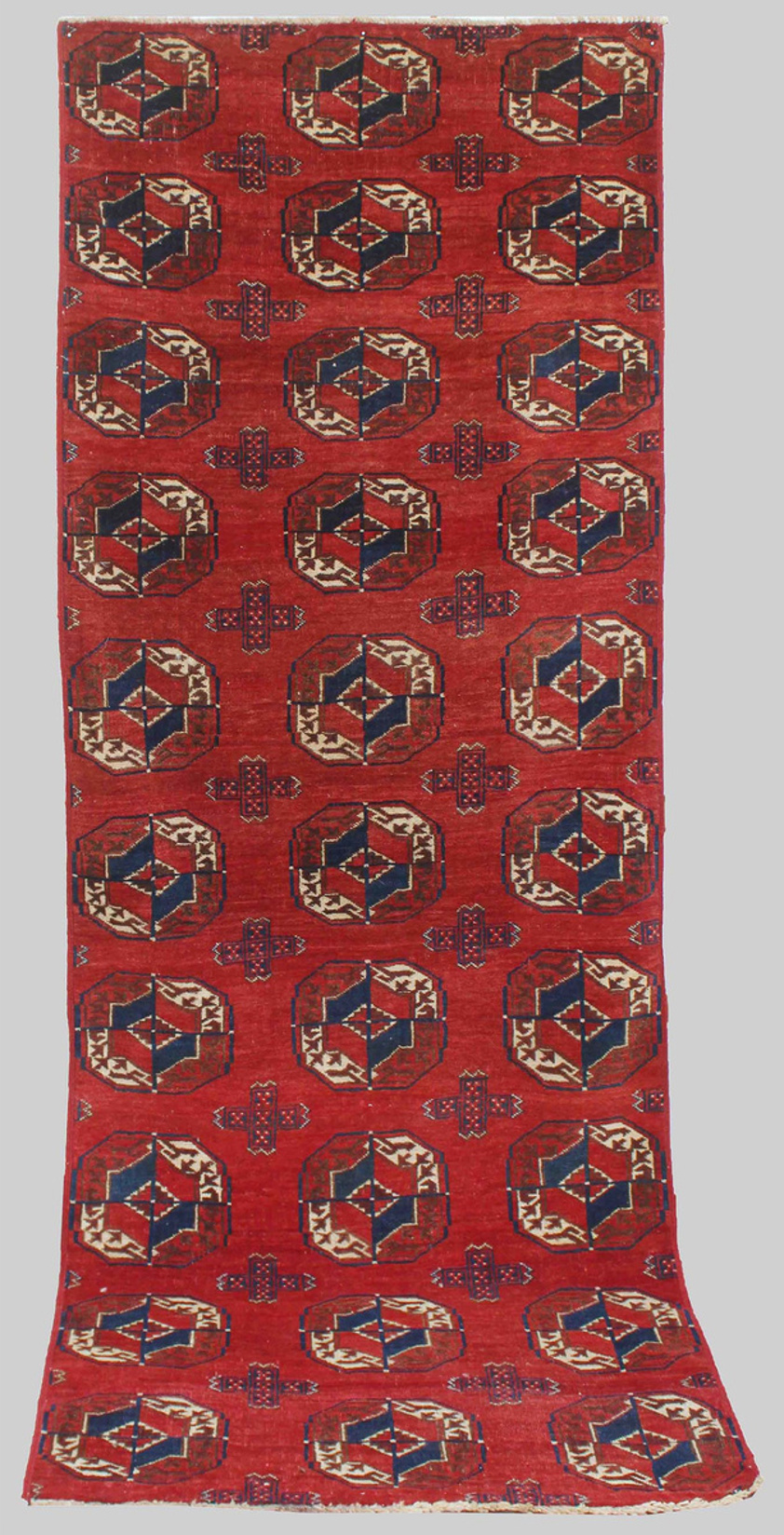
The Ersari name belongs to the wider Turkmen weaving traditions of Central Asia. Historically, Ersari designs developed in contact with neighbouring Persian decorative vocabularies as well as other Turkmen groups. Repeated guls and small subsidiary motifs are among the resources of that broader textile world. This vintage Persian Ersari runner gives them a particularly clear red setting and a compact, elongated format. Dark octagonal guls repeat in three columns through the red field of this runner. Cream angular lines divide their interiors into smaller geometric sections, with red and blue notes creating further changes inside the dark outlines.
Small cross-like devices occupy the intervening spaces. The framing remains narrow, allowing the gul arrangement to supply most of the pattern. Each gul has enough open colour inside for its angular divisions to be followed separately. The smaller crosses provide a finer rhythm between the columns, preventing the red intervals from reading as wholly empty.
From one end, the runner would appear as an orderly sequence of dark ornaments; beside it, the cream turns, little blue passages and changing internal sections would give a more intricate view. Measuring 195 × 80 cm, it could suit a short hallway or a clear passage beside a bed. Plain cream fabrics would answer the internal pale marks, while dark timber could relate to the octagonal outlines. A red object elsewhere would connect with the ground without introducing another pattern.