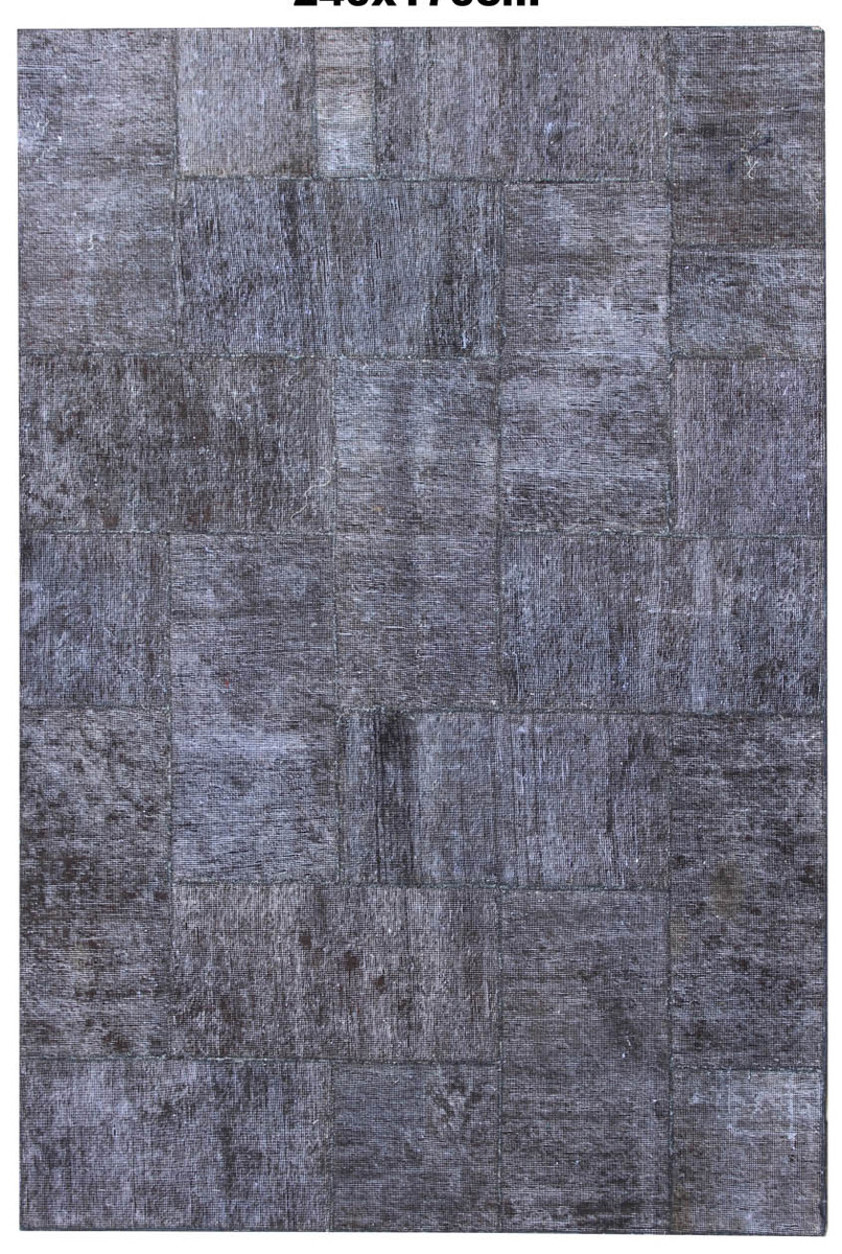
At first glance, this rug reads as a continuous field of soft charcoal grey. Closer inspection reveals a patchwork of different rectangles, some silvery and relatively open, others darker and more closely patterned. The joins are clear enough to establish the arrangement without introducing a sharp outline around every panel. Large sections towards the middle give this rug a slower, calmer rhythm than a patchwork made entirely from small pieces. Narrower rectangles around them introduce changes of direction, while faint floral fragments add fine detail.
The distinction between light and dark is subtle, leaving the surface varied but visually quiet. There is no separate border or central medallion to impose a formal hierarchy. The 170 by 240 centimetre rectangle would provide a restrained foundation for a study or a compact living room. Its greys would suit oak, blackened metal or pale painted furniture. A warm cream fabric would soften the charcoal, while a little deep blue nearby could pick up its cooler notes.
Leave some of the broad central panels visible to appreciate the quieter variations in their drawing. Within the decorative repertoire of Afghan rugs, floral motifs often work alongside a strongly organised framework. This patchwork takes a more fragmented approach, setting small passages of ornament within independent grey panels. The rectangular arrangement becomes the main design, while the traditional drawing is encountered in traces rather than read as a complete field.