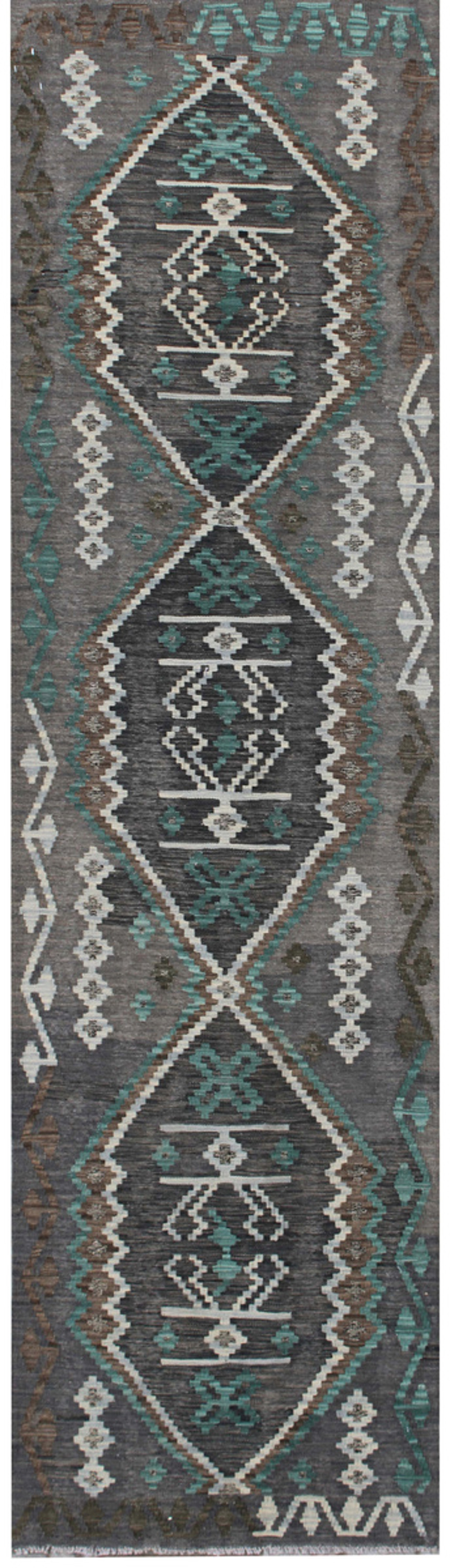
Cream outlines define three elongated medallions on the charcoal field of this Afghan kilim runner. Each contains a pale angular centre with turquoise and muted green details. Narrow zigzag lines and small geometric motifs occupy the side spaces, giving the long composition interest beyond its central sequence. Compact end bands repeat the same angular vocabulary and provide a clear finish. The dark background has fine horizontal changes of tone, softening the contrast with the cream drawing. Turquoise is used selectively, bringing a cooler accent to the internal motifs and border details. The medallions narrow where they connect, creating a continuous line through the runner.
Pale outlines remain the strongest features, making the pattern easy to recognise along its length without becoming visually dense. The kilim method interlaces coloured wefts with warp threads to produce a flat textile and its ornament. It differs from carpets with a raised knotted pile. Angular boundaries and repeated geometric units are particularly compatible with this construction. Afghan runners adapt these forms to elongated proportions, using connected centres and continuous edges to sustain a balanced design across a narrow surface.
This runner could define a hallway with light walls and plain flooring. Cream woodwork would echo the outlining, while a small turquoise accessory would pick up the quieter colour. It would also suit a bedside placement with simple fabrics. Leaving visible floor along both sides would preserve the zigzag edges and allow the three principal medallions to guide the eye through the space.