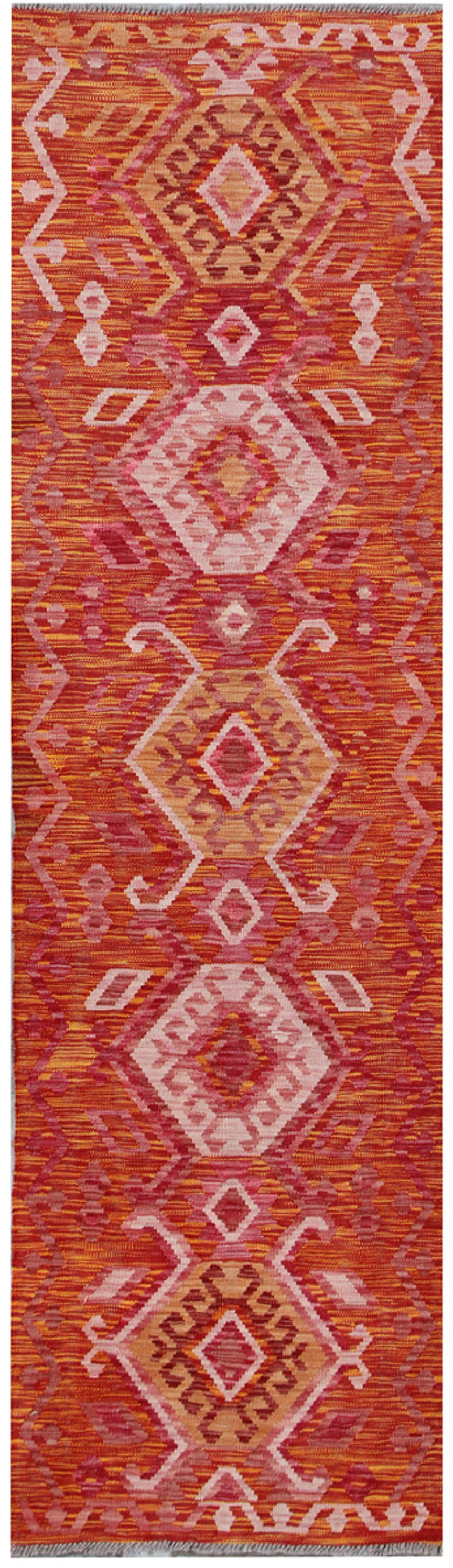
Alternating diamonds form a long central sequence on this rug. Some have broad pale pink interiors; others are darker red with ochre hooked edges and little contrasting centres. The ground is a close mixture of red, orange and warm yellow, giving the whole surface a lively horizontal grain. Small pale lozenges occupy the intervals, and larger hooked outlines extend towards the narrow sides. This rug measures 301 × 83 cm, making its proportions especially useful for a passage or a long area beside furniture.
The warm palette would enliven pale timber or stone flooring, while the pink outlines offer a gentler note within the dominant reds. The repeated design reads coherently from either end, an advantage where a rug is approached in both directions. Kilim is part of a broad domestic textile tradition across Afghanistan and its neighbours. Geometric motifs can be adapted to narrow formats by extending them into chains, preserving their visual rhythm along a longer axis.
Related angular forms also occur in wider rugs and household bags, demonstrating the flexibility of this design language. Here the medallion interiors change enough to reward a slower look. Their pale and dark alternation prevents the long field from becoming monotonous, while the continuous warm ground ties every section together. This rug would be particularly effective with plain surrounding walls, allowing its changing central sequence to provide most of the decorative detail along the passage.