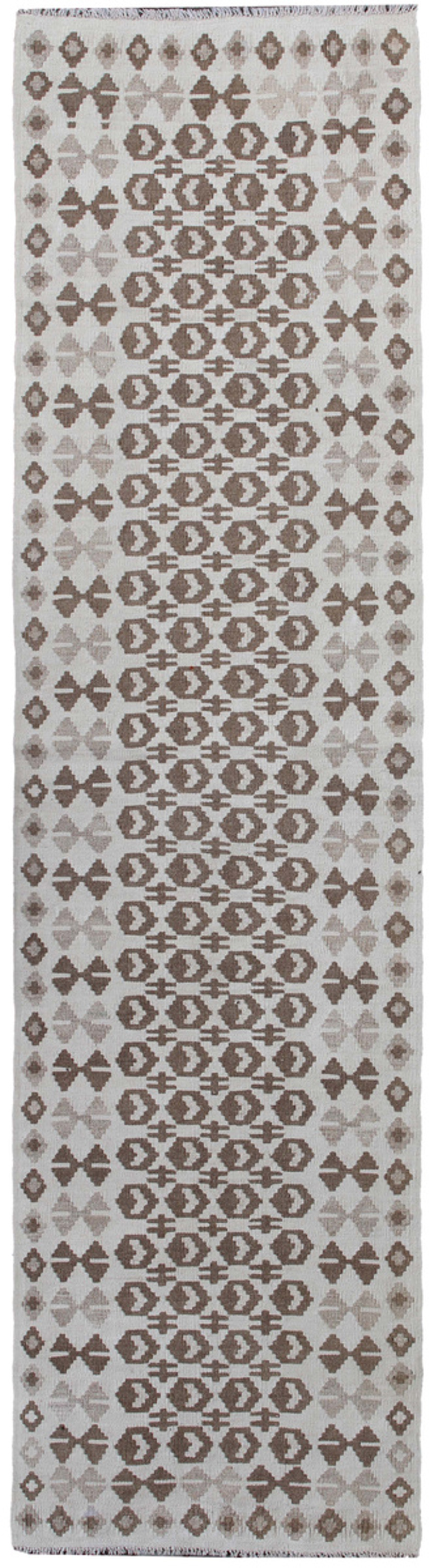
A narrow sequence of linked geometric shapes carries the pattern along this runner. Taupe and ivory distinguish small hexagonal compartments and their curled angular centres, with little diamonds repeating down the sides. The darker interior forms have a finer scale than the long overall rectangle. Pale intervals separate them, keeping the central sequence clear within its closely patterned frame. At 293 × 78 cm, this runner would suit a slender hallway or an open passage beside a bed.
Plain walls would give the small geometry a quiet setting, while warm grey paintwork could refer to the darker motifs. A clear view along the length would show how the central rhythm differs from the finer side bands. The design belongs to the broad geometric repertoire associated with Afghan kilims. Flatwoven textiles have a long domestic history across Central and West Asia, with repeated cells and bands adapted to different formats.
An elongated runner gives those devices a particularly strong direction, allowing small changes to unfold in sequence rather than around a single large centre. Here, several internal curls are dark and distinct, while nearby compartments remain paler. The fine edge diamonds make a steady enclosing line. Seen from the end, the runner reads as a light patterned strip; nearer the middle, individual cells and their tiny internal divisions become more noticeable. The restrained taupe-and-ivory palette lets those changes of drawing provide the interest without requiring a broad range of colours.