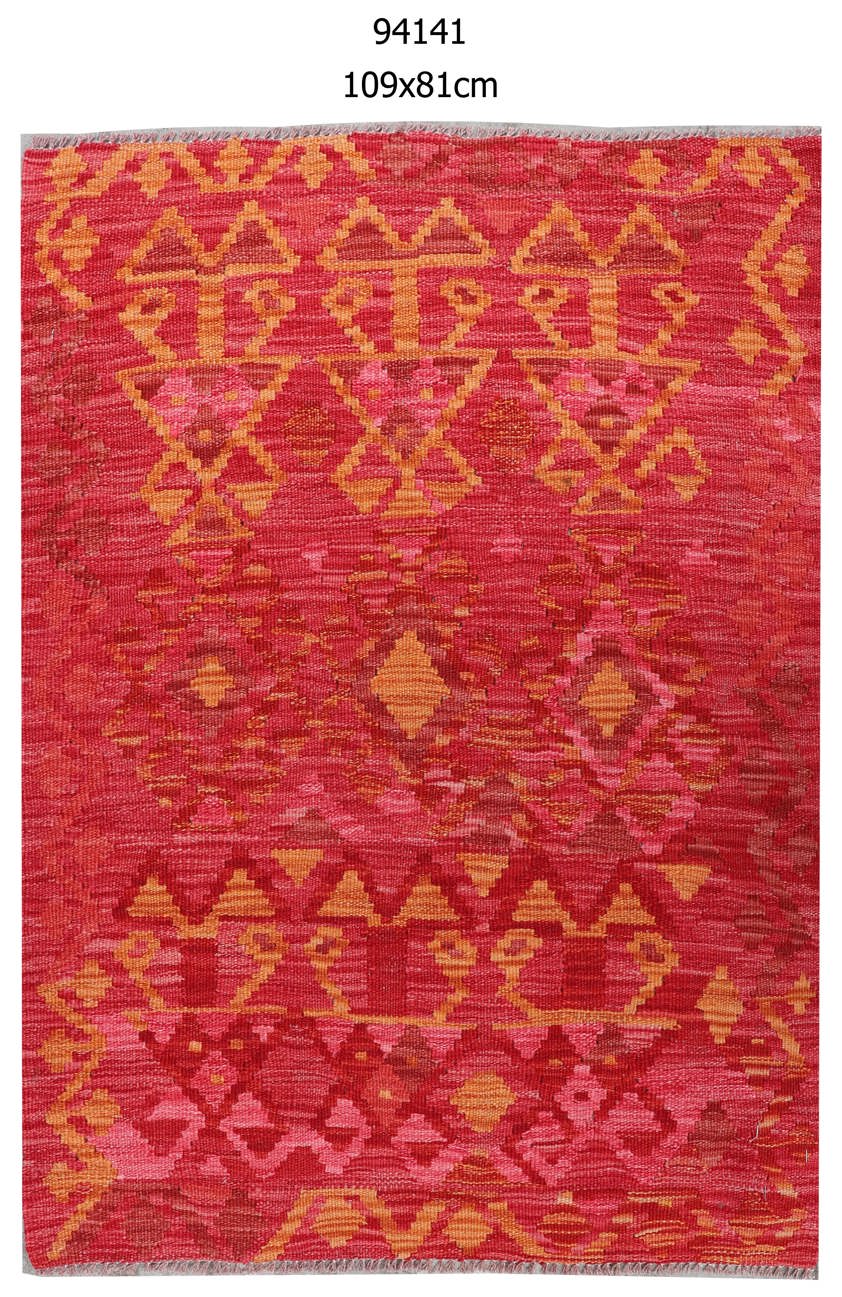
Orange geometry is drawn across the rose-red field of this Afghan kilim rug. Small diamond centres sit within broader, lightly outlined angular forms. Turning lines and compact geometric units mark the upper and lower areas, while the middle remains comparatively open. The palette moves between pink, coral, orange and deeper red, making colour transitions as significant as the outlines themselves. Fine horizontal bands create a varied surface throughout the ground. Some orange details are bright and distinct, while others blend more softly into nearby red passages.
The central pair establishes direction without heavy enclosing bands. Near the ends, the denser geometry gives the composition a firmer finish, balancing the quieter space around the small interior diamonds. In kilim weaving, changes of coloured weft form the visible pattern around the supporting warp. The result is a flat textile without an added knotted pile.
Geometric design need not depend on sharp light-and-dark contrast: related warm shades can define a structure more gradually. This rug shows that tonal approach, using fine angular drawing and small centres within a broadly continuous red field. A pale stone floor or cream-painted wall would give the warm colour room to register. Dark timber could provide a grounding companion, with coral accessories echoing the lighter passages. Leaving the middle open would reveal the smaller diamonds and allow the horizontal colour changes to contribute their quieter detail at close range.