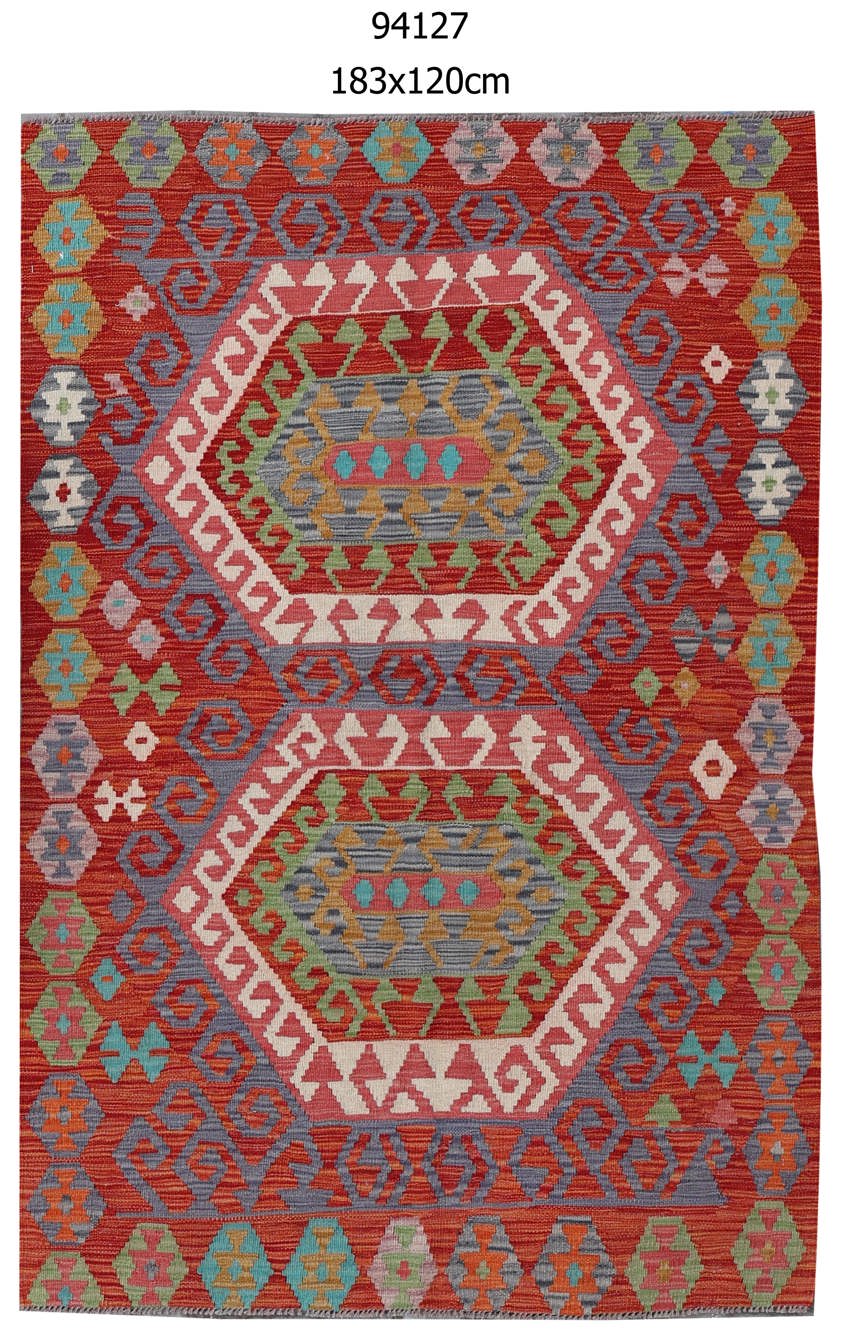
Two broad hexagons dominate the vivid red field of this Afghan kilim rug. Cream hooked bands enclose green, ochre, blue and pink layers, with small geometric figures running through their interiors. Blue linked outlines fill parts of the surrounding red ground. Across the ends and sides, compact multicoloured units establish a continuous smaller rhythm around the principal pair. The pale hooks give the centres a strong outer edge. Inside them, the bands alternate between warm and cool colours, while fine horizontal shifts add variation to the larger red areas.
The upper and lower medallions differ in their finer details. Those changes make the repeated structure lively, and the surrounding figures ensure that the design remains active beyond its two dominant enclosures. Kilim flatweaving creates both fabric and pattern through coloured wefts interlacing with a warp. Its surface has no knotted pile. A shared angular vocabulary can operate at several scales, from a large enclosing hexagon to a tiny linked unit.
This rug makes that range particularly apparent, combining substantial central forms with much finer supporting motifs while repeated colours hold the different areas together. Simple cream seating would provide a calm setting for the strong red field. Blue or ochre accessories could connect with selected inner bands. An open table would leave parts of both centres visible, while exposed edges would retain the changing perimeter units and show how they complete the broad central arrangement.