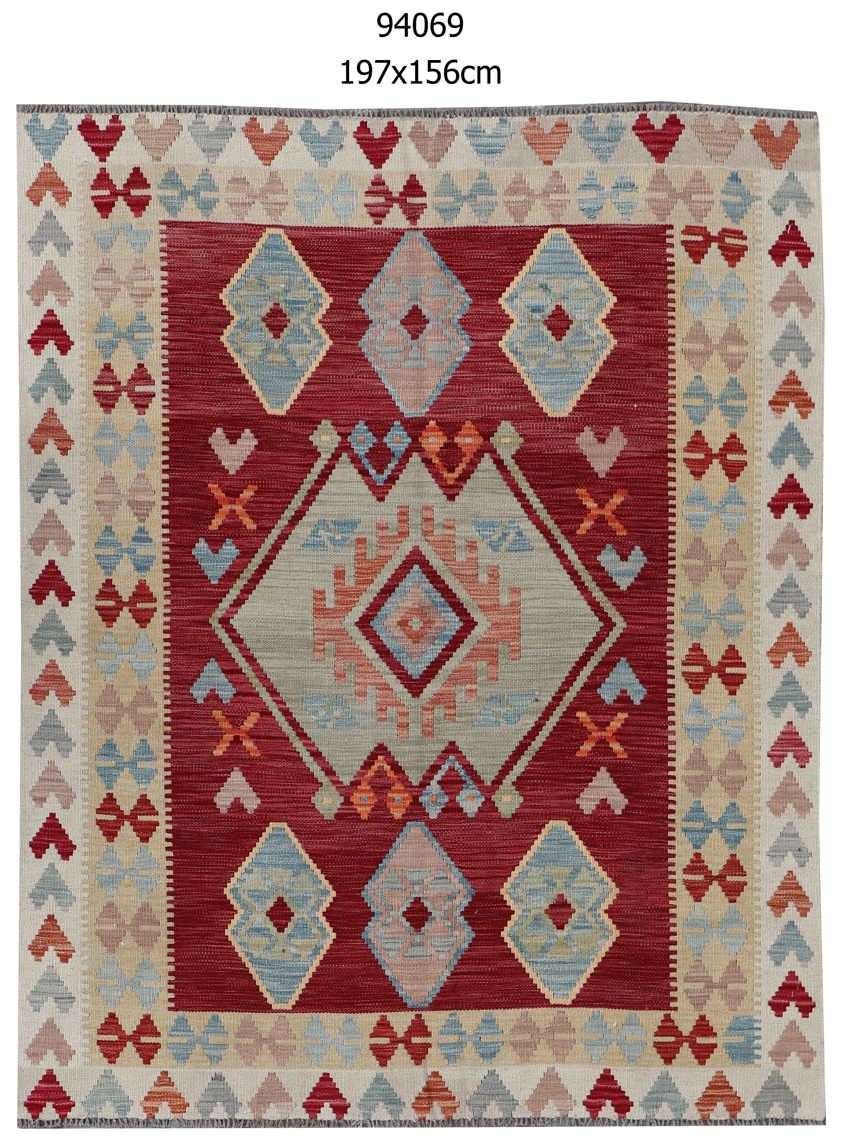
A pale central hexagon stands within the red panel of this Afghan kilim rug. Narrow angular outlines surround its smaller blue and red diamond centre. Six separate diamond panels sit above and below the main form, each with a compact red interior. An ivory frame carries repeated geometric units, giving the darker middle a light enclosing rhythm around the perimeter. Fine horizontal shading is visible through the red and pale blue.
The smaller panels vary slightly in their internal colouring, while the large centre retains the strongest structural emphasis. Open intervals around the medallion keep the field readable rather than densely filled. The border repeats several central colours at a smaller scale, connecting its compact figures with the more spacious geometry inside the panel. Kilim construction makes pattern through coloured wefts crossing warp threads. It creates a flat textile without knotted pile. Stepped boundaries can organise a dominant central enclosure or be reduced into small repeated units.
Afghan kilims use this flexibility to balance a principal medallion with supporting compartments and borders, maintaining coherence through recurring outlines while varying scale, colour and spacing across the surface. This rug would work with plain cream fabrics, natural wood and softly coloured walls. A blue accessory could echo the inner bands, while muted red details would relate to the panel. An open table would preserve the large hexagon and some smaller diamonds. Keeping the ivory frame exposed would retain the light transition to the floor and show its complete geometric repeat.