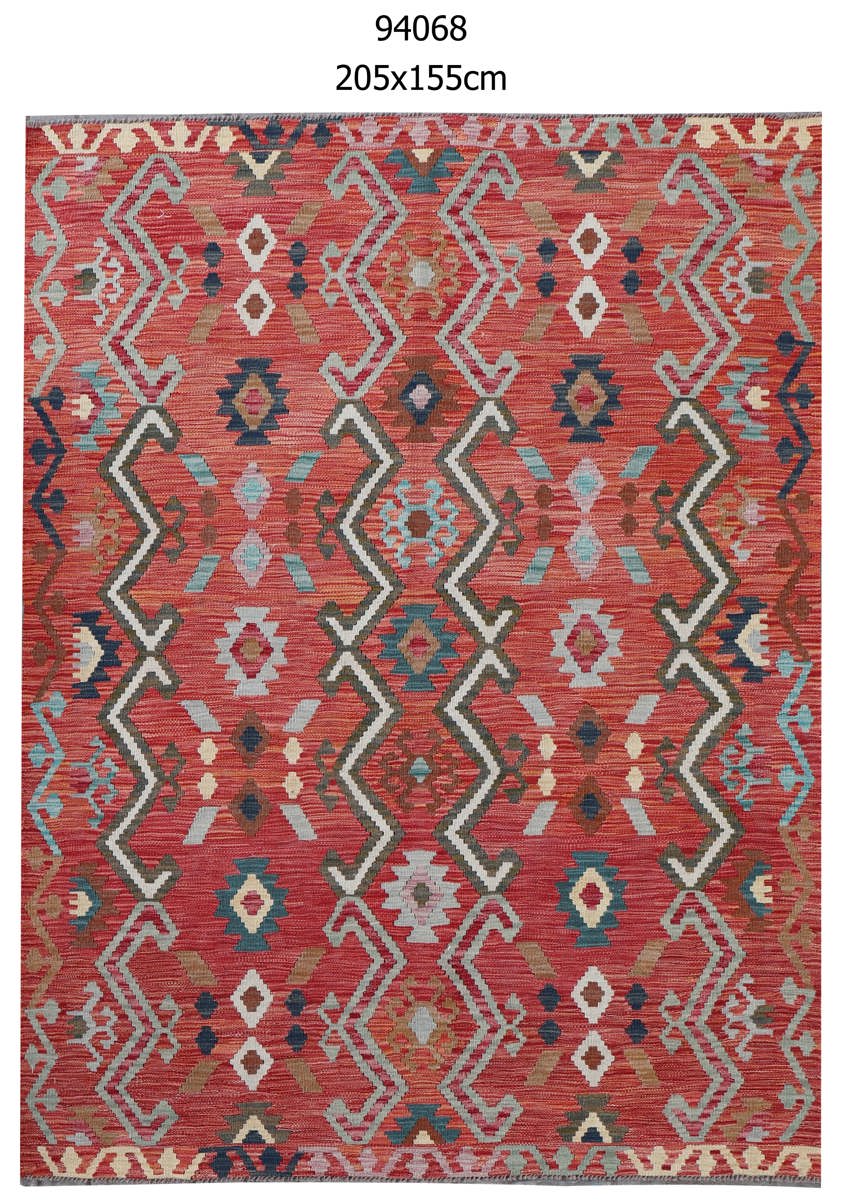
Fine angular columns divide the red field of this Afghan kilim rug. Cream, blue, green and dark outlines turn around small multicoloured centres, creating a repeated structure across the width. Separate pale diamond figures fill the intervals. Narrow edge details finish the perimeter, keeping the field dominant rather than enclosing it inside a broad contrasting border. The design gives line and open colour areas equal importance. Some centres are compact and strongly outlined, while others have softer internal contrast. Fine horizontal shading moves through the red, adding depth within the broad ground. The repeated columns provide a consistent framework, but changing small figures keep the surface varied.
From farther away the long angular lines are most apparent; nearby the many individual centres become clearer. Kilim flatweaving forms its pattern as coloured wefts interlace with warp threads. It produces a flat textile without knotted pile. Connected stepped boundaries can organise a field into continuous bands or separate compartments. Afghan kilims use these structural possibilities to distribute detail widely, allowing repeated outlines to maintain order while colours and internal motifs change within the broader arrangement.
This rug would suit plain cream upholstery and natural timber furniture. Accessories could echo a few selected blue or green centres. The distributed pattern would remain decorative around an open table, even where some columns are partly concealed. Quiet walls would leave room for the fine pale lines to remain legible, while a visible margin of floor would emphasise the complete rectangular field.