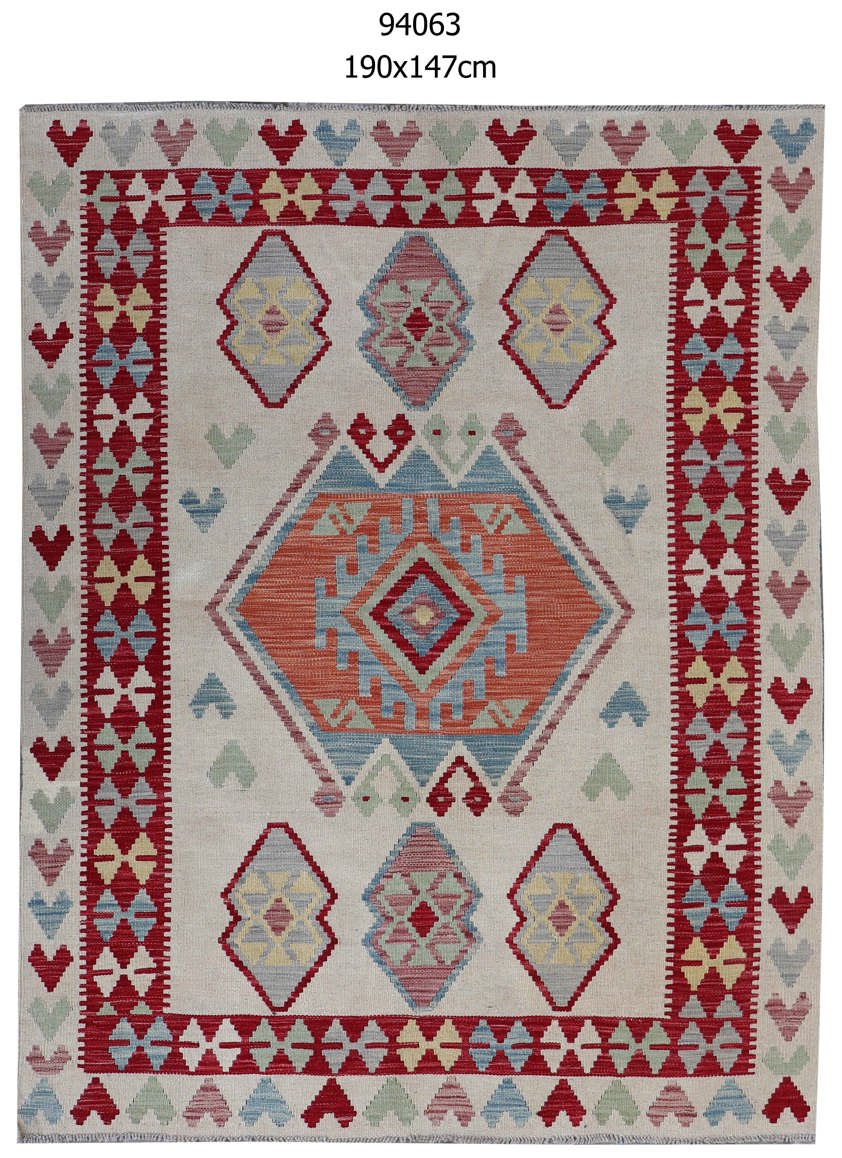
An orange hexagon provides the focus of this Afghan kilim rug. Pale angular lines surround a small nested diamond inside the centre, while six smaller diamond panels are arranged above and below it. The ivory field leaves generous open intervals around those forms. A red geometric border repeats compact pale units, and larger scattered motifs mark the outer edge, giving the composition several distinct scales of pattern. Fine horizontal shading is visible in the orange and pale blue bands. The smaller panels vary in their internal colours, with red centres supplying continuity.
The broad central enclosure remains the strongest feature, while the border's quicker repeat provides clear definition around the light ground. Pale space is therefore as important as the individual motifs in the reading of the design. Kilim flatweaving creates its pattern as coloured wefts interlace with warp threads. The resulting textile has no knotted pile. Angular boundaries can enlarge a small figure into a dominant medallion or be repeated as compact compartments.
Afghan kilims use these changes of scale and spacing to balance a principal focus with supporting panels, connecting separate areas through recurring colours and outlines. This rug would suit cream upholstery, pale timber and quiet walls. An open table would preserve the large hexagon and leave some smaller panels visible. Orange accessories could echo the centre, while a muted red detail would connect with the border. Keeping the ivory field exposed would retain the spacious character around the clearly divided geometry.