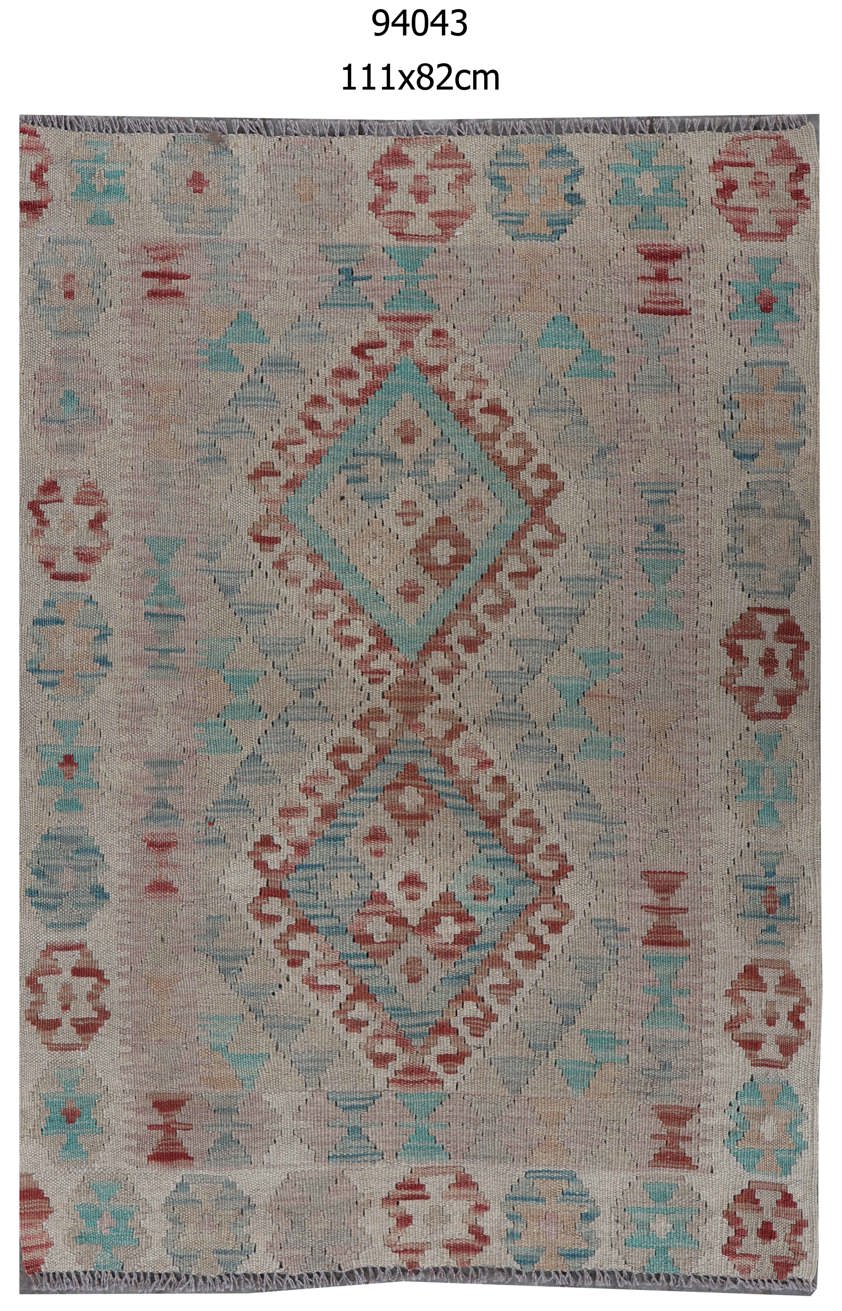
Muted rose hooks surround two pale blue centres on this Afghan kilim rug. Cream and warm neutral bands expand around their small geometric interiors, while separate roundels and angular figures occupy the sides. The ground is light and finely shaded. A narrow outer finish allows the larger pair to remain the main structure without adding a broad dark frame around the open field. The hooked lines become more apparent at close range, where their repeated turns can be followed around each centre.
Fine horizontal variation softens the blue and pink. Small differences within the two interiors preserve individuality, while the more widely spaced side figures introduce another rhythm. The palette remains restrained, with darker red accents providing local points of definition rather than a continuous heavy outline. Kilim flatweaving forms its pattern as coloured wefts cross warp threads. It produces a flat textile without knotted pile. Nested angular boundaries can organise large enclosures or compact supporting units.
Afghan kilims use these differences of scale to balance a consistent central arrangement with finer variation across the surrounding field, allowing shade and small internal figure to enrich an otherwise repeated structure. This rug would suit pale wood, cream fabrics and softly coloured walls. A muted rose accessory could echo the hooks, while blue-grey upholstery would connect with their lighter setting. An open table would preserve both centres. Quiet surrounding patterns would give the finer side roundels and subtle horizontal colour changes room to remain visible nearby.