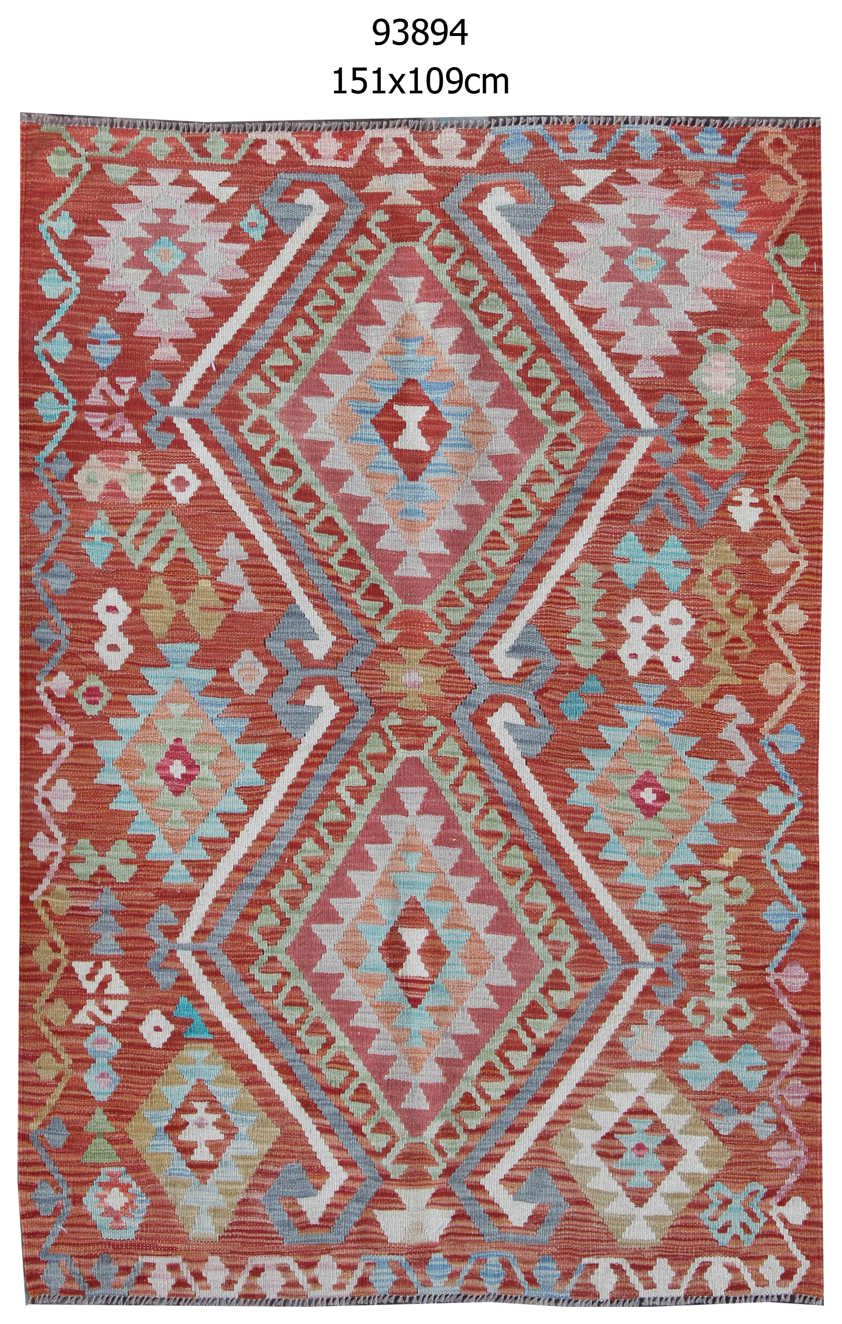
Two pale blue diamonds organise the red field of this Afghan kilim rug. Cream hooks and narrower blue bands lead towards small red centres, while long angular outlines connect the principal forms. Smaller geometric side panels contain light blue, cream and warm-toned figures. A narrow patterned frame completes the rectangle, repeating the central palette at a finer scale. The larger outlines remain clear from across a room, while the many small internal details become more apparent nearby.
Fine horizontal shading softens the red and blue. Pale bands create light intervals between darker layers, keeping the nested structure legible. The side panels introduce a different rhythm from the paired centres, broadening the composition without competing with its main vertical direction. Kilim construction forms a patterned flat textile through coloured wefts crossing warp threads. It has no knotted pile. A stepped boundary can become a broad enclosing band, a fine hook or a compact supporting unit.
Afghan kilims combine these related scales to connect dominant centres with detailed surrounding fields, maintaining a coherent overall arrangement while allowing colour and internal motif to vary. This rug would suit plain cream upholstery, natural wood and quietly coloured walls. Blue accessories could echo the central bands, while red details elsewhere would connect with the ground. A table with slender legs would preserve both diamonds. Keeping some side panels exposed would show the full breadth of the design and allow their smaller figures to remain visible at close range.