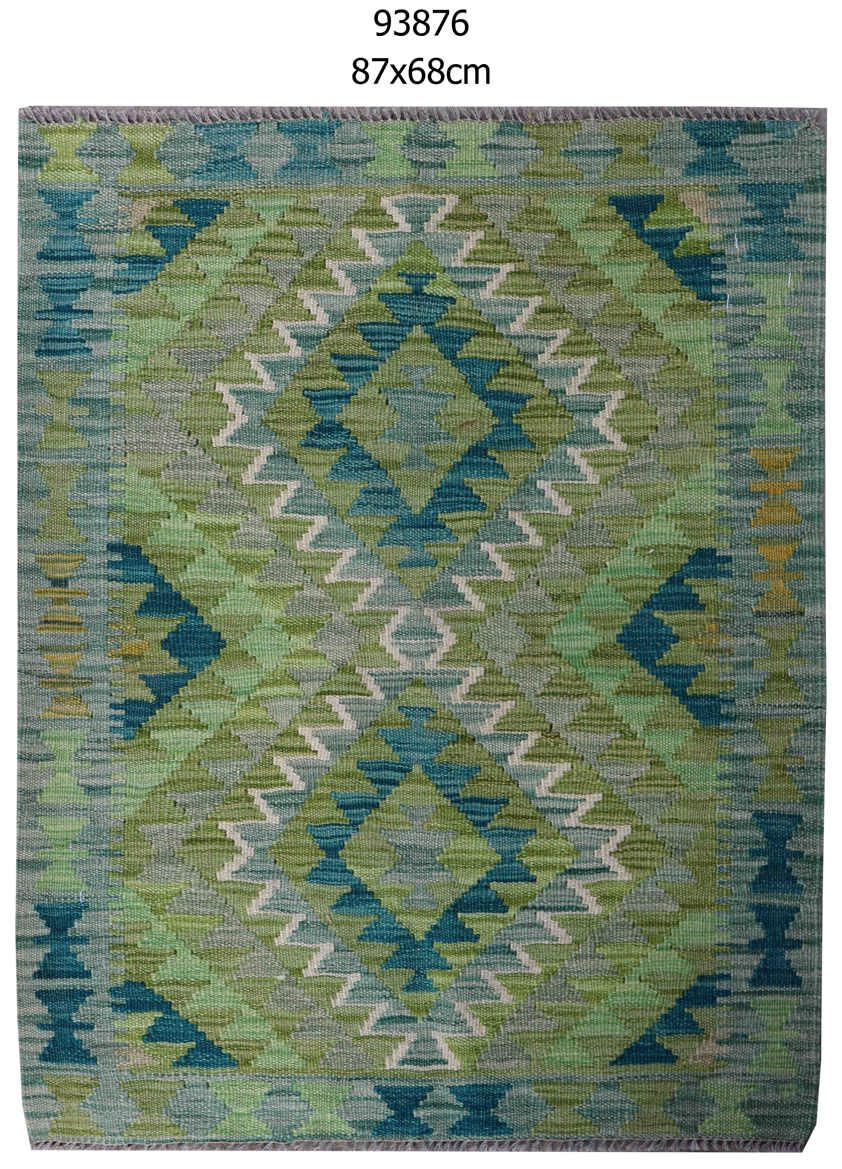
Green stepped bands surround two blue diamond centres on this Afghan kilim rug. Pale yellow and cream layers lead towards small green interiors, while darker blue and olive figures occupy the surrounding field. A narrow outer edge completes the compact rectangle. The central pair is clearly linked, with broad colour bands giving each diamond a generous enclosure despite the rug's modest proportions. Fine horizontal shading passes through green, blue and cream. Pale outlines lift the main geometry, while darker side figures provide smaller points of emphasis.
The upper and lower interiors vary slightly in their central colouring. The perimeter remains understated, leaving the paired diamonds and their changing bands to supply most of the decorative structure rather than a separate heavy border. Kilim construction forms a patterned flat textile through coloured wefts interlaced with warp threads. It has no knotted pile. Stepped boundaries can separate successive colour areas, allowing a small centre to expand into a larger nested motif. Afghan kilims use this structural vocabulary in both strongly contrasted and softly blended palettes, with changes of shade adding variation inside a consistent geometric framework.
This rug would work beside pale timber, cream linen or muted green upholstery. A blue ceramic could echo the central bands, while quiet walls would give the finer shading room to register. Keeping both diamonds visible would preserve their balanced relationship. Plain surrounding fabrics would allow the smaller dark side figures to remain apparent at close range.