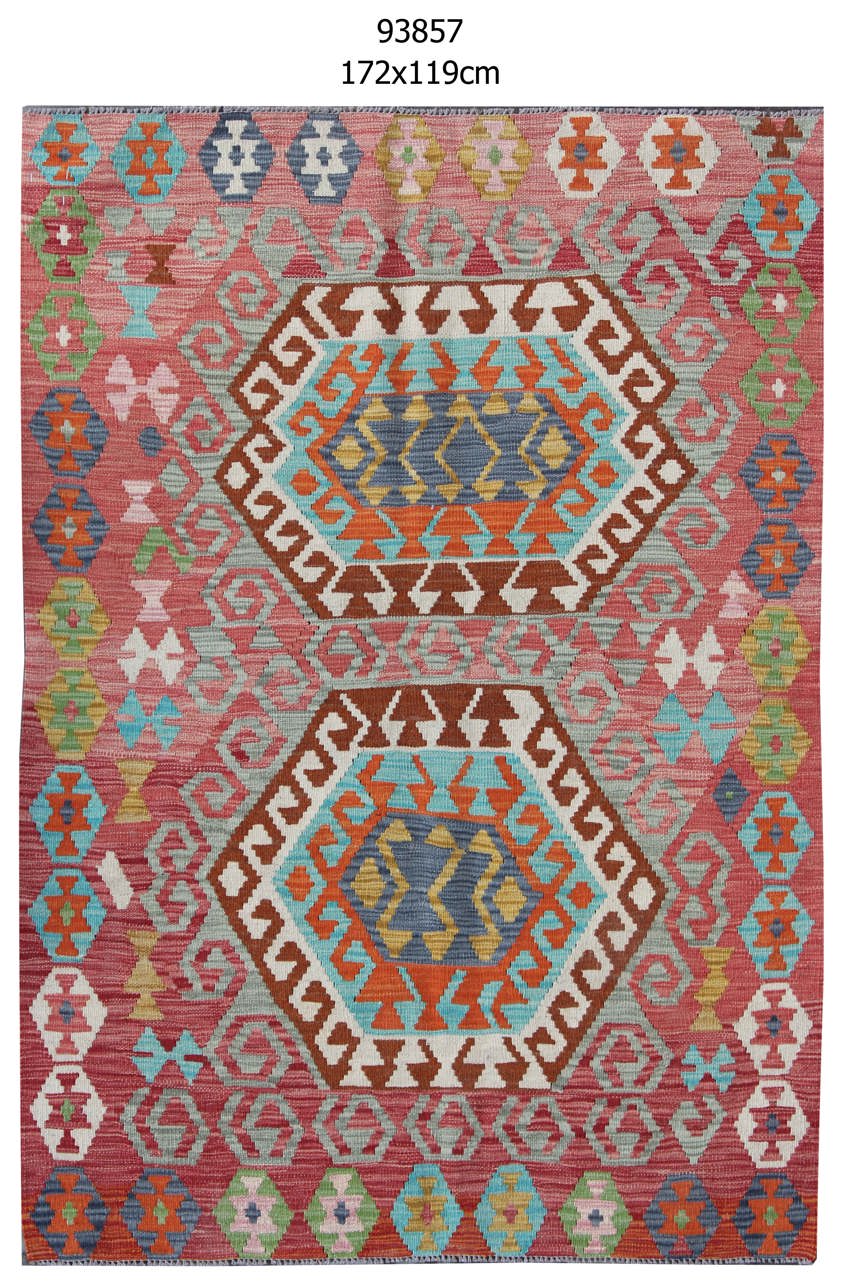
Two broad hexagons dominate the pink field of this Afghan kilim rug. Cream and dark brown bands surround turquoise, orange and yellow layers, leading towards small blue geometric interiors. Around them, a closely worked network of pale angular figures fills the field. Narrow perimeter details repeat the main colours at a smaller scale. Fine horizontal shading adds depth within the pink and turquoise.
The large centres remain clear because the cream bands provide strong light intervals between the darker outlines and brighter internal colour areas. Nested forms are closely compatible with kilim flatweaving. Coloured wefts cross the warp to create a patterned flat textile without knotted pile. Successive angular boundaries can build a dominant motif from a small centre, while related units organise the surrounding field. Afghan kilims use these differences of scale to connect a readable principal arrangement with fine local detail, allowing the internal colours of repeated forms to change.
This rug could bring concentrated colour to a small seating area with plain cream upholstery. Turquoise accessories would echo the inner bands, while dark timber could relate to the deeper outlines. An open table would preserve both hexagons and their layered interiors. Quiet walls would leave room around the stronger pink and orange. Keeping some surrounding field visible would show the finer geometric network that completes the composition between the larger forms.