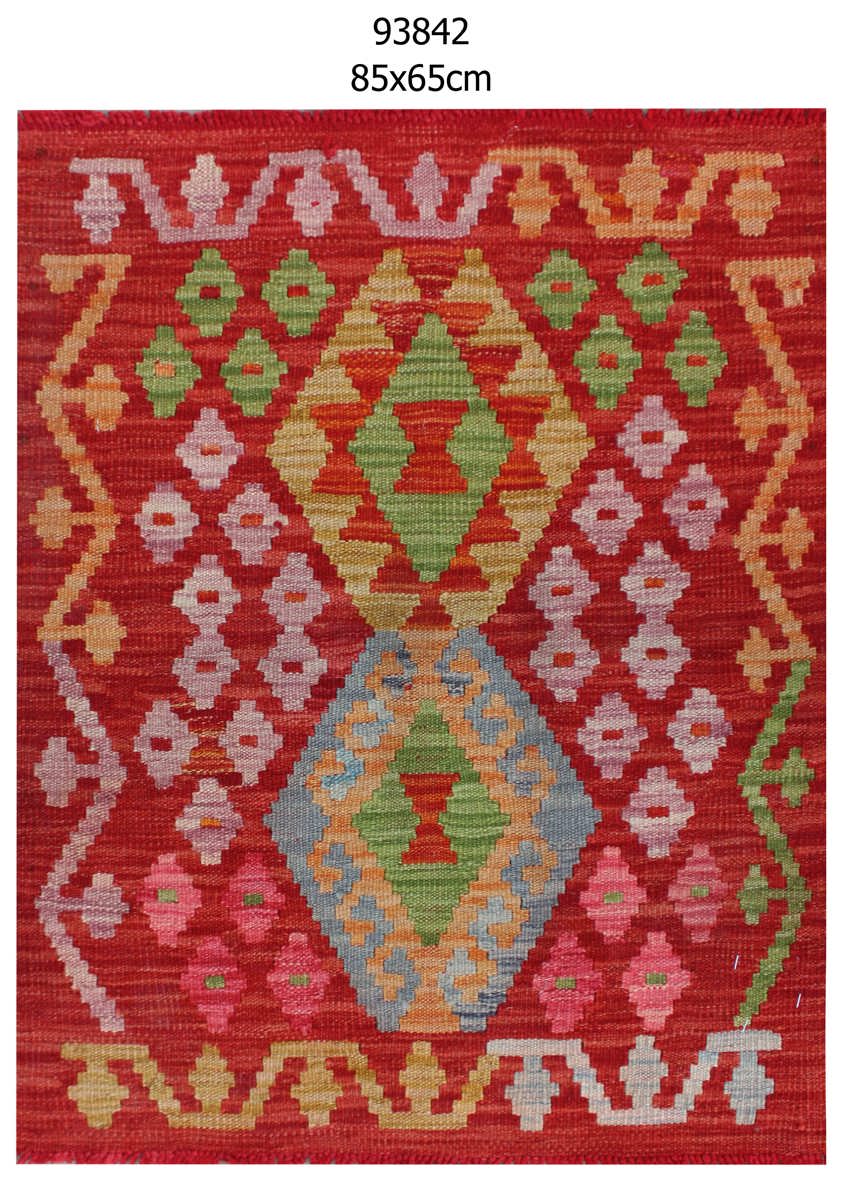
Green and blue hexagons form a colourful pair on the red field of this Afghan kilim rug. Warm orange details surround small green centres, while yellow hooked lines trace broader turns around the main forms. Pale pink and cream units occupy the side areas. The end bands repeat short angular figures, giving the composition a clear frame within its compact proportions. The upper centre has a stronger green emphasis, while the lower one introduces more blue and orange.
Fine horizontal shading softens the red ground and gives the flat surface depth. Yellow links the central outlines with the perimeter, and pale side figures offer brighter pauses around the darker forms. The shared geometry keeps the changing colours organised rather than scattered across the field. Kilim flatweaving creates pattern as coloured wefts interlace with the warp, forming a textile without knotted pile. Nested angular boundaries can contain several shades within one coherent motif, while related hooks and small units organise the surrounding space.
Afghan kilims use this structural flexibility to balance repeated central forms with local changes of colour and detail, especially in compact compositions with limited room for separate panels. This rug would work beside plain cream upholstery or pale wooden furniture. Green or blue accessories could draw out either centre, while quieter walls would leave space around the red. Keeping both hexagons uncovered would preserve their different interiors. Simple surrounding fabrics would let the lighter side motifs remain visible at close range.