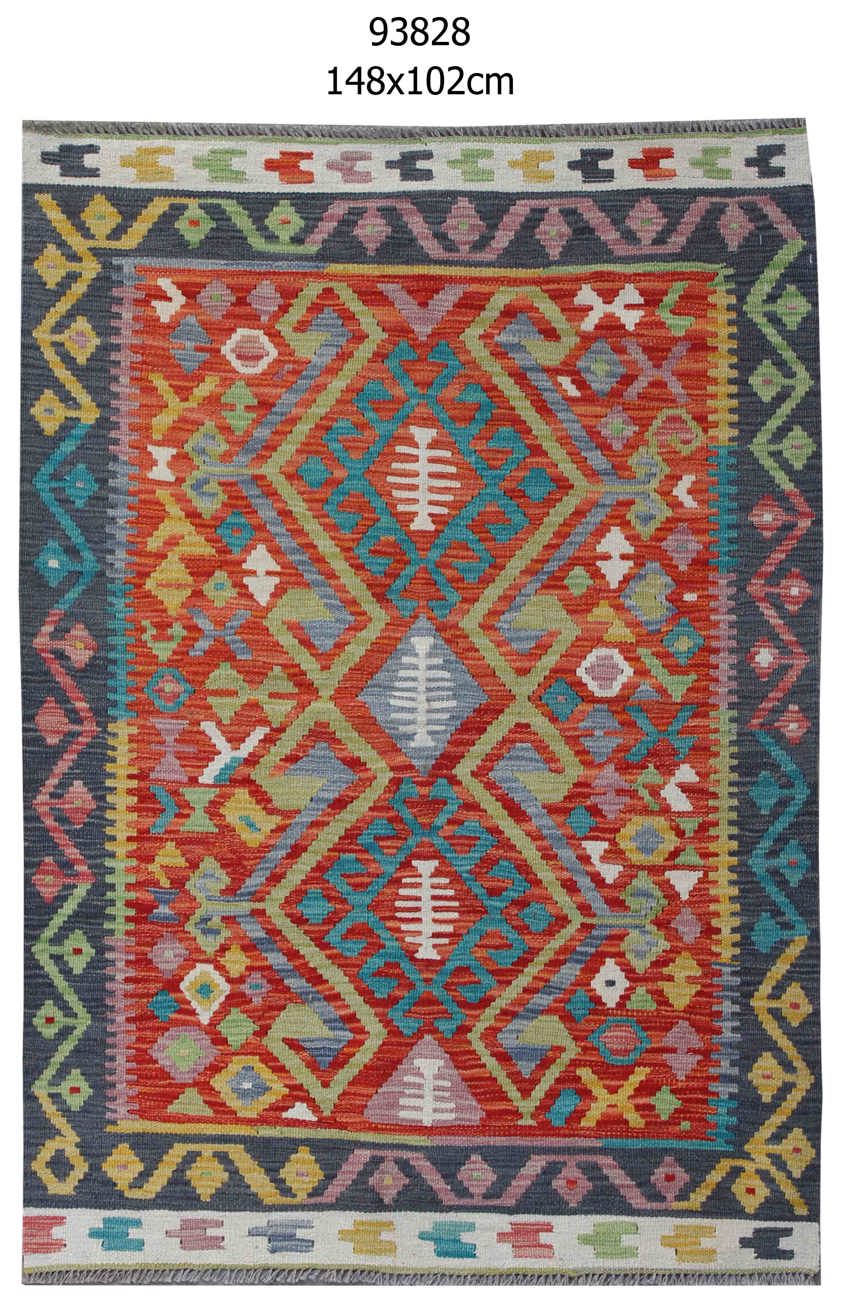
Turquoise hooked centres stand against the red field of this Afghan kilim rug. Long yellow and cream angular bands turn around the principal pair, linked through smaller pale figures along the middle. A navy border carries multicoloured hooks and separate geometric units. Light end bands contain short changing details, giving the darker frame a clear finish at either end. The red field is more densely worked than the border, with fine pale motifs filling many of the smaller intervals. Turquoise provides a cool emphasis inside the centres, while yellow makes the larger outlining bands easy to follow.
Fine horizontal colour shifts add texture within the flat surface. The change from bright middle to darker frame gives the whole composition a strong sense of enclosure. The connected geometry is closely suited to kilim flatweaving. Coloured wefts interlace with warp threads to create pattern within a flat textile without knotted pile. A stepped boundary can become an enclosing line, turn into a hook or be reduced into a compact supporting unit.
Afghan kilims use these relationships to organise elaborate fields while keeping their main structure clear. This rug would work with plain cream upholstery and natural timber. Turquoise accessories could echo the central hooks, while navy details would connect with the border. A table with slender legs would preserve more of the linked arrangement. Quiet walls would leave space around the brighter colours and allow the finer side motifs to remain visible nearby.