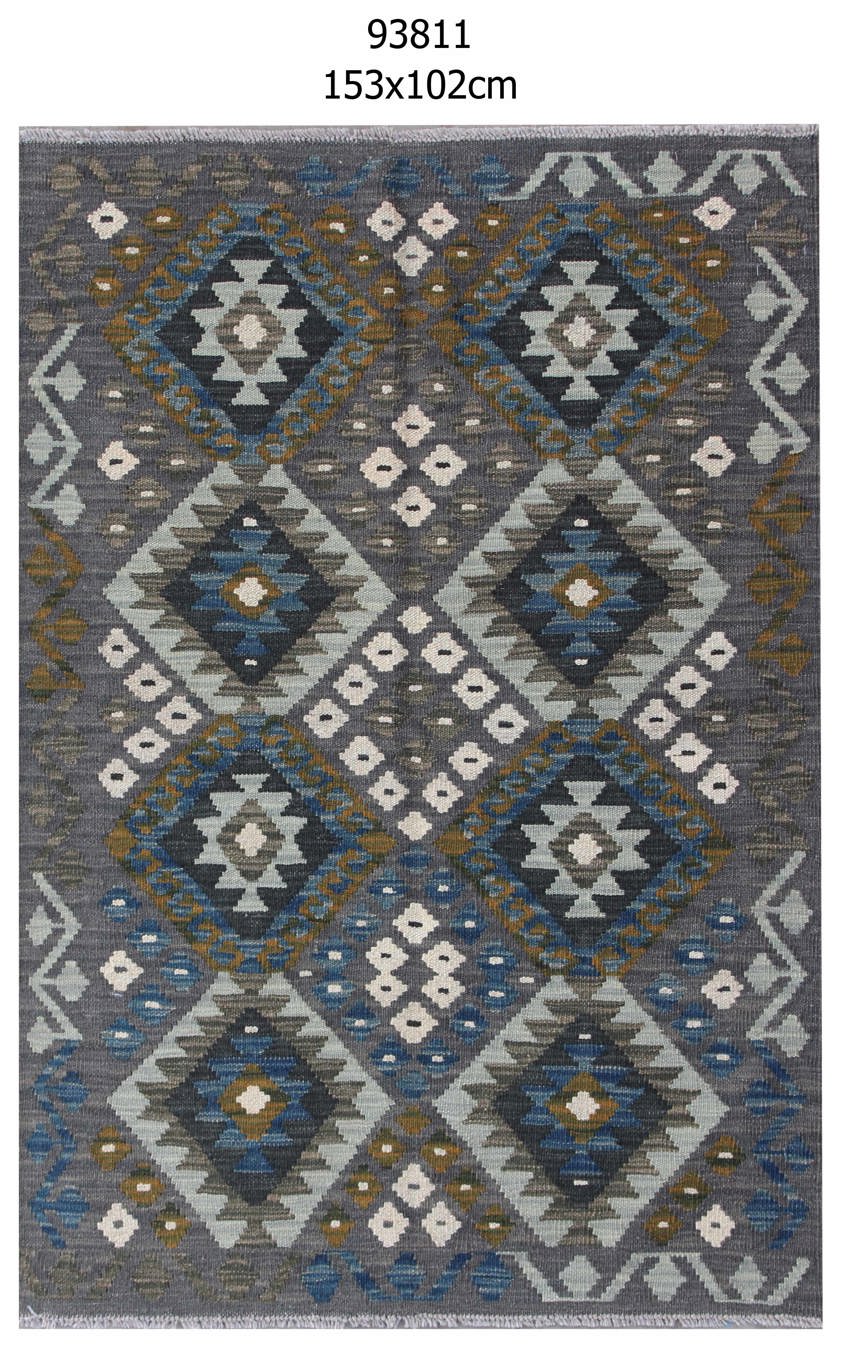
Eight diamond panels are arranged across the charcoal field of this Afghan kilim rug. Pale cream, blue and olive bands surround their small geometric centres. Fine light figures occupy the gaps, creating a second, denser pattern between the larger compartments. The arrangement spreads its emphasis through the surface rather than concentrating attention on one dominant medallion. Some panels have broad pale bands, while others sit closer in tone to the dark ground. This variation creates local contrasts within the restrained palette. Fine horizontal shading moves through grey, navy and muted olive, giving the flat surface depth.
Narrow edge details finish the rectangle, repeating related angular figures without introducing a heavy separate frame around the already closely worked field. Kilim flatweaving creates its pattern through coloured wefts interlaced with warp threads. It forms a textile without knotted pile. Connected angular boundaries can divide a field into compartments while leaving room for smaller repeated motifs between them.
Afghan kilims use such changes of scale to give all-over designs both order and variety, with differences of light and dark helping individual forms remain legible. This rug would complement cream upholstery, dark timber or plain grey furniture. Muted blue accessories could connect with the cooler panels, while ochre details would echo the warmer centres. The distributed pattern would retain interest around an open table. Quiet surrounding fabrics would allow the fine fillers to remain apparent nearby, and a visible strip of floor would emphasise the complete rectangle.