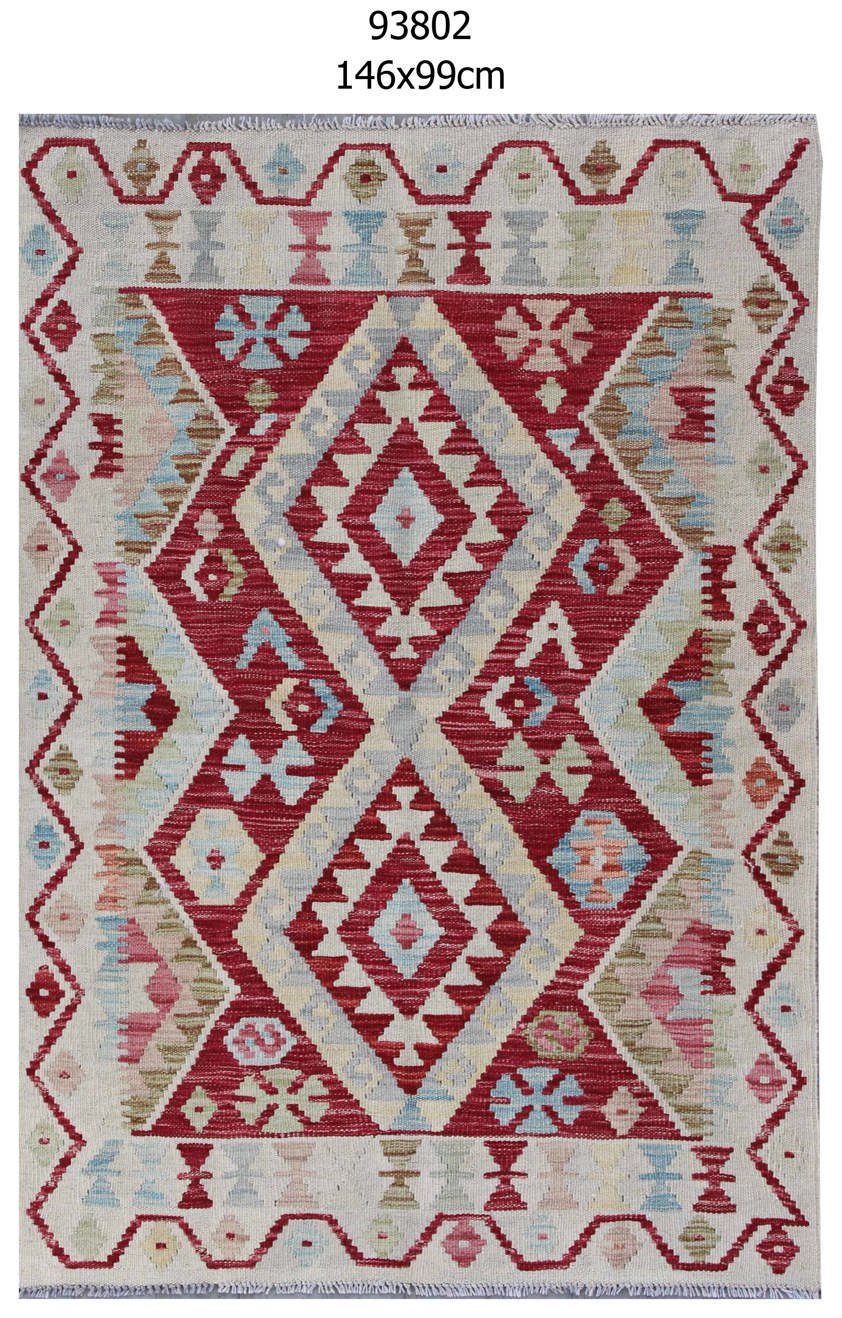
Bold ivory diamonds stand against the burgundy field of this Afghan kilim rug. Red stepped outlines surround smaller pale centres, while blue bands broaden the main forms towards the sides. Fine geometric emblems fill the darker intervals. A light outer border carries compact upright figures and a narrow turning line, providing a clear enclosing rhythm around the central pair. The ivory creates the strongest contrast, making the two centres easy to read from across a room. Nearby, the smaller red and blue internal details become more apparent. Fine horizontal shading softens the broad light bands.
The perimeter is more openly patterned than the burgundy field, giving the composition a useful change of pace without introducing unrelated colours or motifs. The angular structure is closely compatible with kilim flatweaving. Coloured wefts cross the warp to create pattern within a flat textile without knotted pile. A small central shape can expand through nested boundaries into a larger medallion, while related units fill the surrounding field. Afghan kilims use these differences of scale to combine a clear principal arrangement with finer detail at the sides and edges.
This rug could define a small seating area with plain upholstery and natural timber. Cream fabrics would connect with the large diamonds, while blue accessories could echo the surrounding bands. A table with slender legs would preserve their stepped outlines. Quiet walls would allow the burgundy field and pale centres to provide the main contrast, leaving the finer border figures visible nearby.