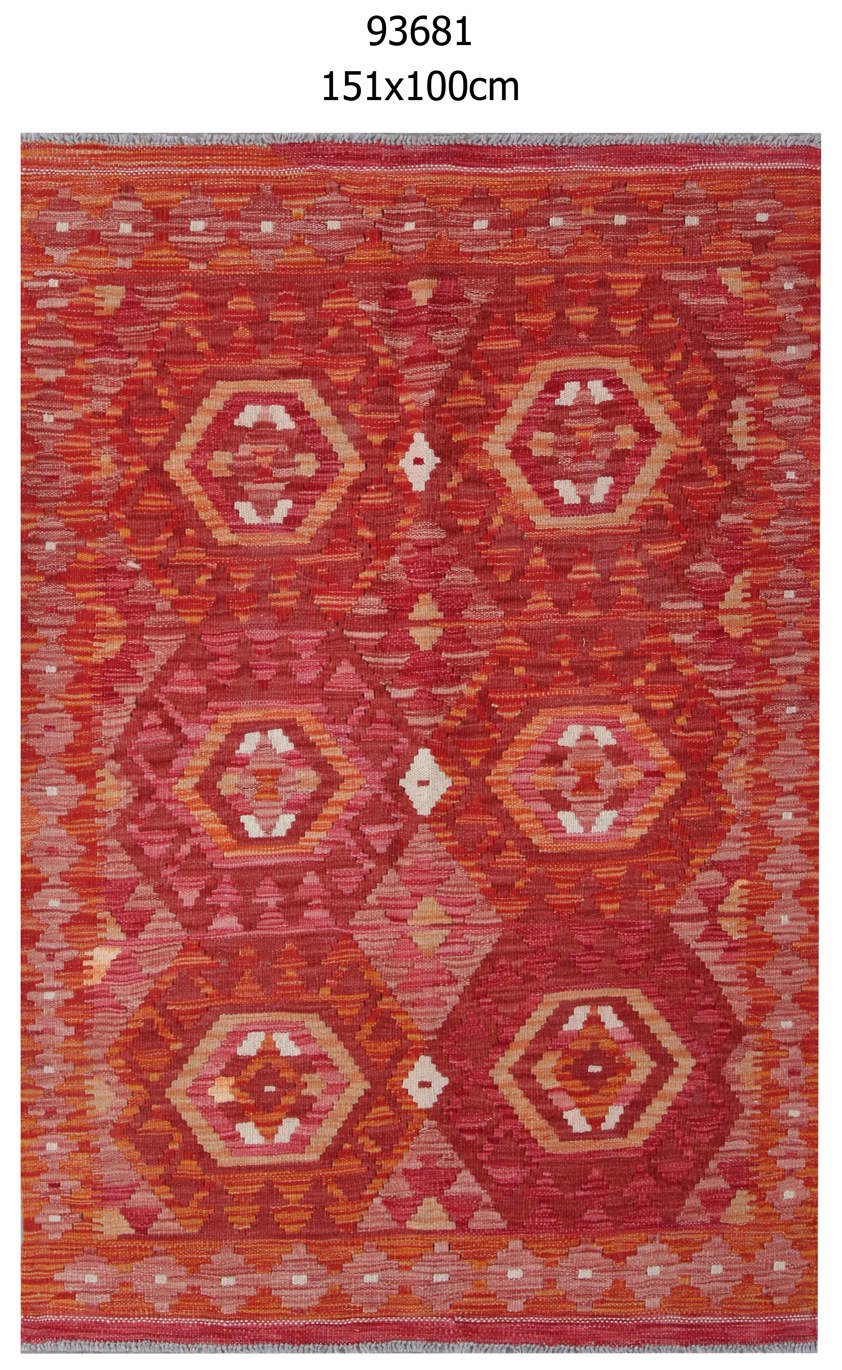
Six hexagonal centres are distributed across the red field of this Afghan kilim rug. Their outlines vary in cream, yellow, pink and orange, with smaller angular figures inside. Fine scattered motifs fill the spaces between them. The design spreads its emphasis across the surface rather than concentrating it around one large medallion, creating an evenly active field. The red changes through warm orange and deeper shaded passages. Pale details are strongest in some centres and quieter in others, giving each a slightly different presence. Along the perimeter, small repeated marks make a narrow frame.
Fine horizontal lines run through the larger colour areas, lending the flat surface visual depth and reinforcing the warm, closely related character of the palette. An all-over arrangement makes particular use of the repeated units available in kilim flatweaving. Coloured wefts interlace with the warp to produce pattern within a textile without knotted pile. Angular outlines can be repeated while their interior colours change, maintaining order without requiring identical motifs. Afghan kilims draw on this flexibility in both framed medallion designs and more widely distributed fields such as this one.
This rug could bring warmth to a small sitting area with cream fabrics and natural wood. The dispersed pattern would retain interest around furniture, even where one or two centres are partly covered. Pale accessories would connect with the light outlines, while muted red upholstery could continue the ground colour. Plain walls would give the finer scattered motifs room to remain visible nearby.