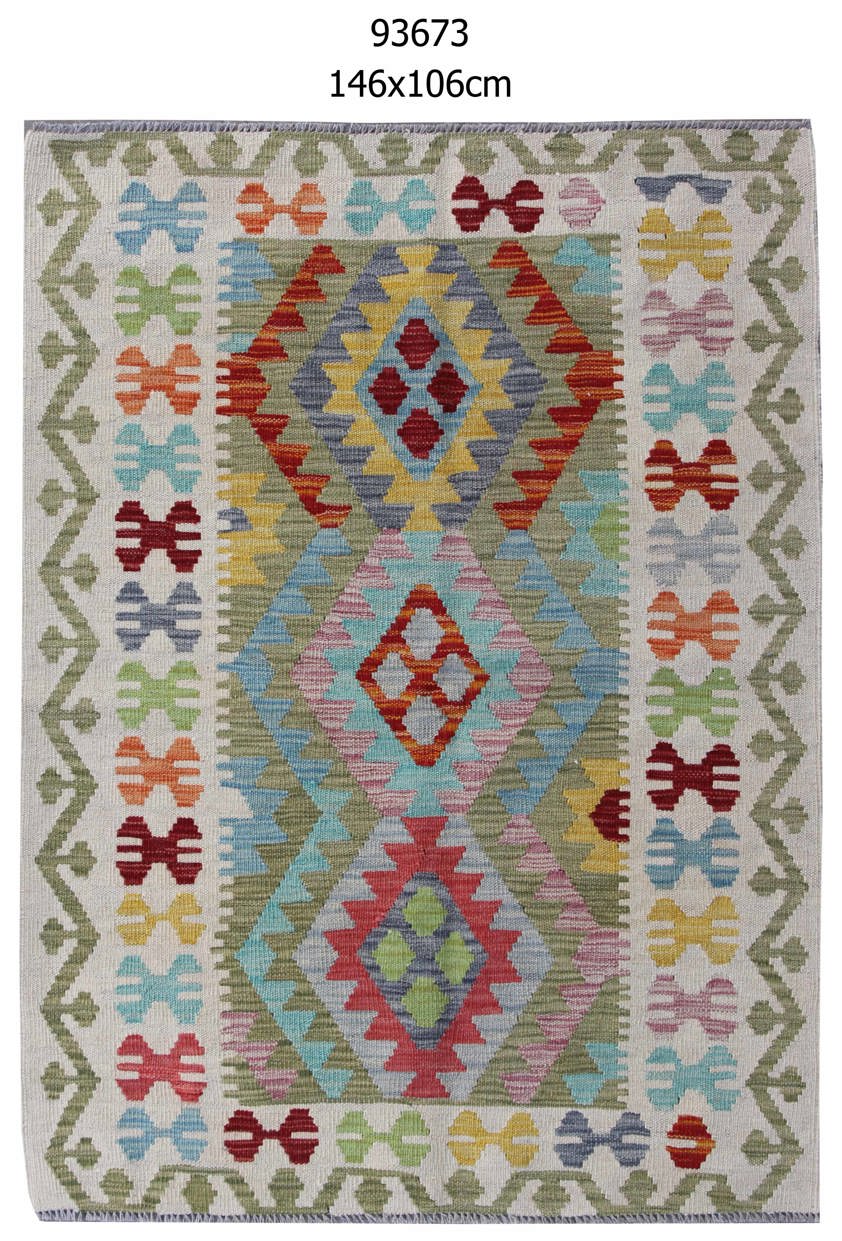
Three pastel centres create a vertical sequence on this Afghan kilim rug. Blue, olive, yellow and pink bands surround smaller red and turquoise details, with the colouring changing from one centre to the next. A pale border carries rows of compact geometric figures. Olive hooks follow the outer edge, gathering the many colours into a clearly enclosed rectangle. The upper centre has a stronger yellow emphasis, while the lower forms introduce cooler blue and green. Between them, stepped bands widen and narrow to keep the sequence connected.
Fine horizontal tonal shifts add visual texture within the flat surface. The pale frame provides a slower rhythm around the closely layered middle, allowing both the larger forms and smaller border units to remain legible. Kilim weaving forms a flat textile through the interlacing of coloured wefts and warp threads.
The pattern is integral to the fabric, without knotted pile. Stepped boundaries can build nested motifs from adjoining colour areas, and related shapes can be repeated at different scales. Afghan kilims use these possibilities to connect a dominant central sequence with a finer surrounding frame while retaining local variation in shade and detail. This rug would work with cream upholstery, pale wood and softly coloured walls. Accessories could draw on a few of its pastel centres rather than repeat every colour. An open table would leave parts of the three-form sequence visible. Keeping the pale border exposed would preserve the light transition between the patterned field and the surrounding floor.