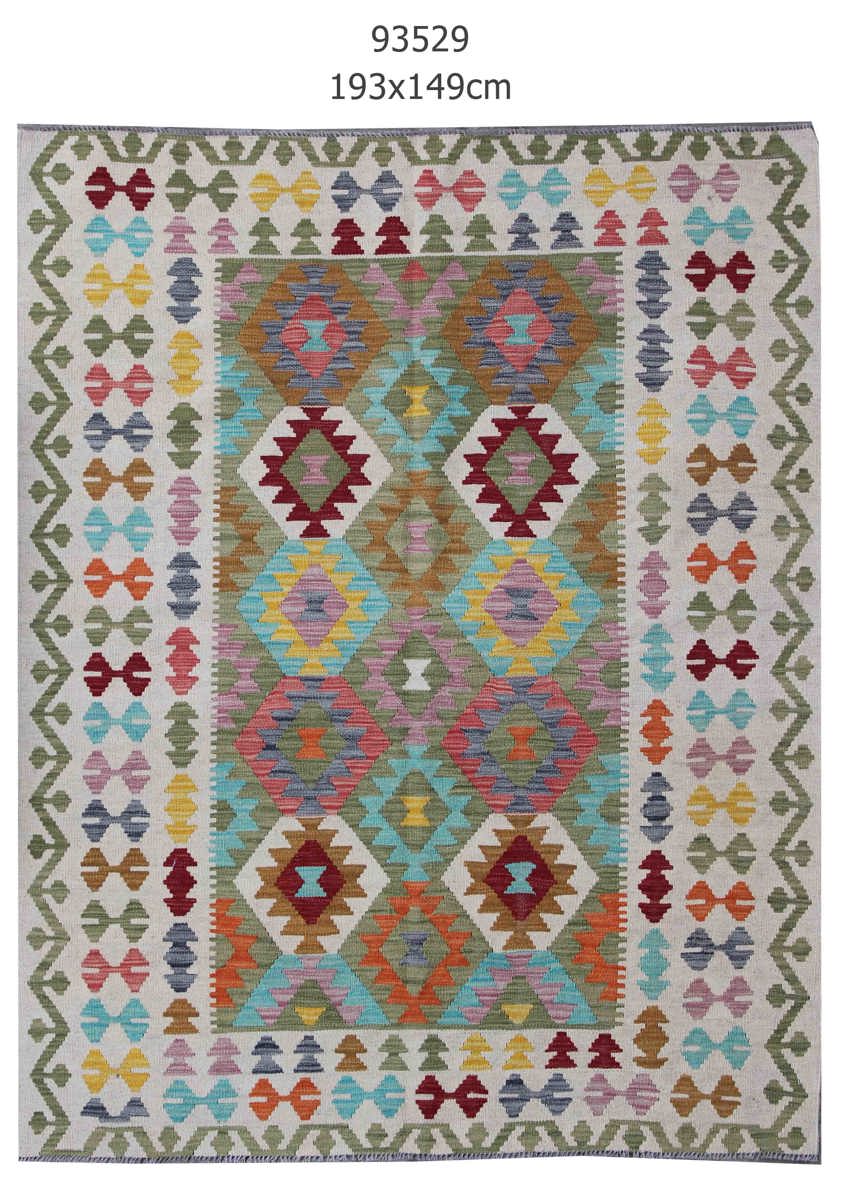
Colourful diamonds fill the green central panel of this Afghan kilim rug. Red, blue, yellow, cream and muted pink appear within their nested centres, giving each larger form a different emphasis. A broad pale border carries small repeated geometric motifs in many of the same colours. Olive hooked lines mark the outer edge, creating a clear enclosure around the lighter frame. The contrast between field and border is gentle but effective. Green gives the diamonds a common setting, while the pale surroundings allow the smaller motifs to remain distinct.
Fine horizontal tonal variation adds visual texture within the flat surface. The central repeat is denser than the border, producing a useful change of rhythm. The colours are varied without losing the underlying order of the diamond arrangement. Kilim weaving uses coloured weft threads interlaced with warp threads to form a flat patterned textile. It is different from construction with knotted pile. Repeated angular units and stepped boundaries are particularly compatible with the method.
Afghan furnishings include many layouts in which a closely worked central panel is balanced by a broader, more open geometric frame. This rug would suit natural wood, plain fabrics and quietly coloured walls. Green accessories could connect with the field, while cream upholstery would echo the border. A small table with open legs would preserve several of the changing centres. The pale frame could offer a light transition to darker flooring, giving a bedroom or intimate seating area a clearly defined decorative foundation.