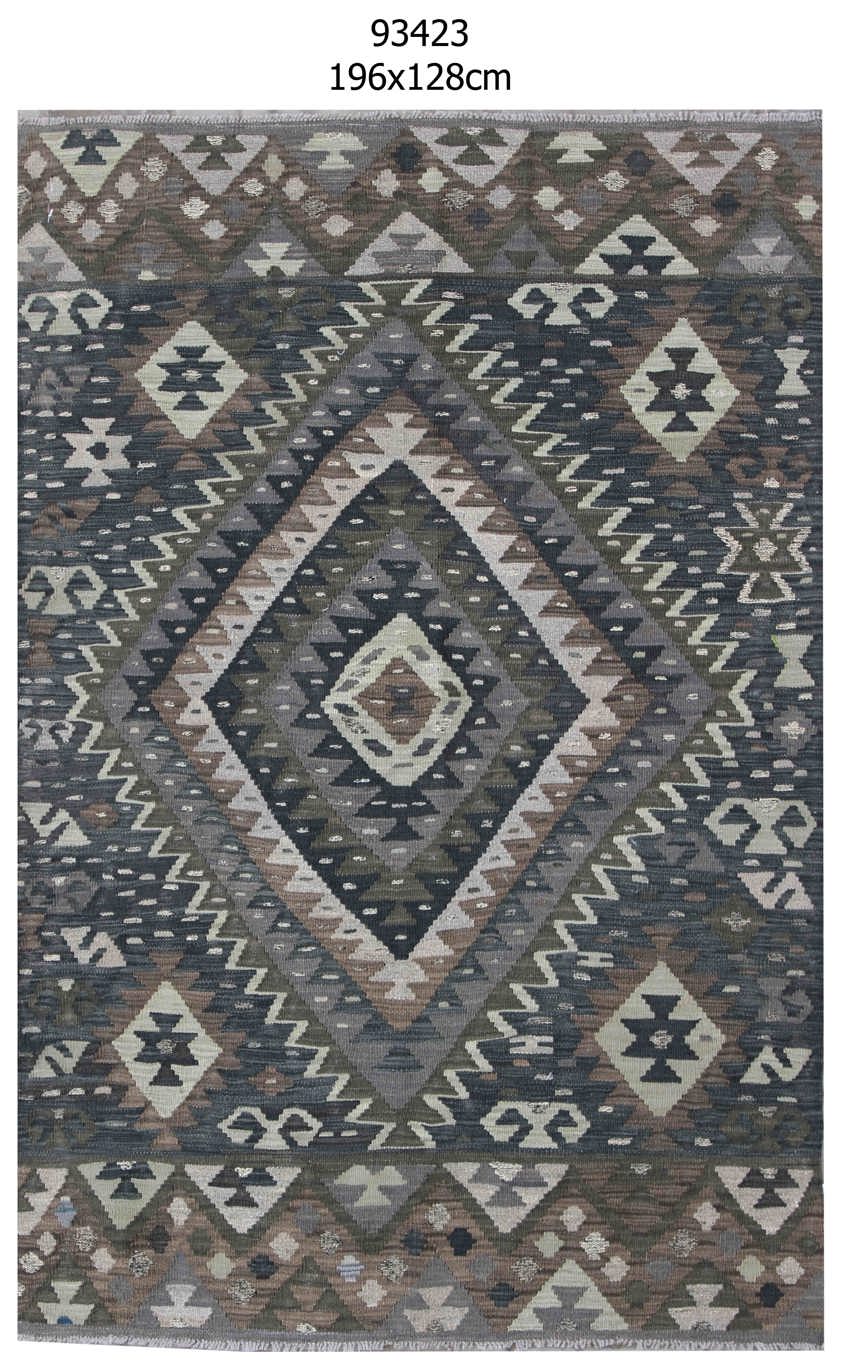
Layered diamonds occupy the centre of this charcoal Afghan kilim rug. Cream stepped outlines build around a smaller internal lozenge, with muted blue, taupe and grey details adding variation between the bands. Pale angular motifs are scattered across the surrounding field. Broad end areas repeat smaller geometric units, giving the composition a balanced frame without introducing a separate bright palette. The shaded ground has fine horizontal colour changes, softening the stronger cream outlines.
Some internal bands are darker than others, creating depth within the central diamond. Smaller side motifs provide additional points of focus and prevent the edges from feeling empty. The overall effect is restrained but intricate, with the pale drawing remaining clear against its darker setting. Kilim construction interlaces coloured wefts with warp threads to produce a flat textile and its pattern. This is distinct from knotted pile weaving. Angular outlines and stepped diagonal lines respond closely to the method, allowing nested forms to be built in several layers.
Afghan kilims use this geometric vocabulary in many compositions, with restrained colours placing particular emphasis on the structure of the design. This rug would work with pale upholstery, natural wood and simple wall colours. Cream accessories could connect with the outlining, while blue-grey fabrics would echo the field. An open-legged table would leave more of the layered centre visible. Its quieter palette could bring detailed pattern to a bedroom or smaller sitting area without requiring a broad range of strong colours elsewhere.