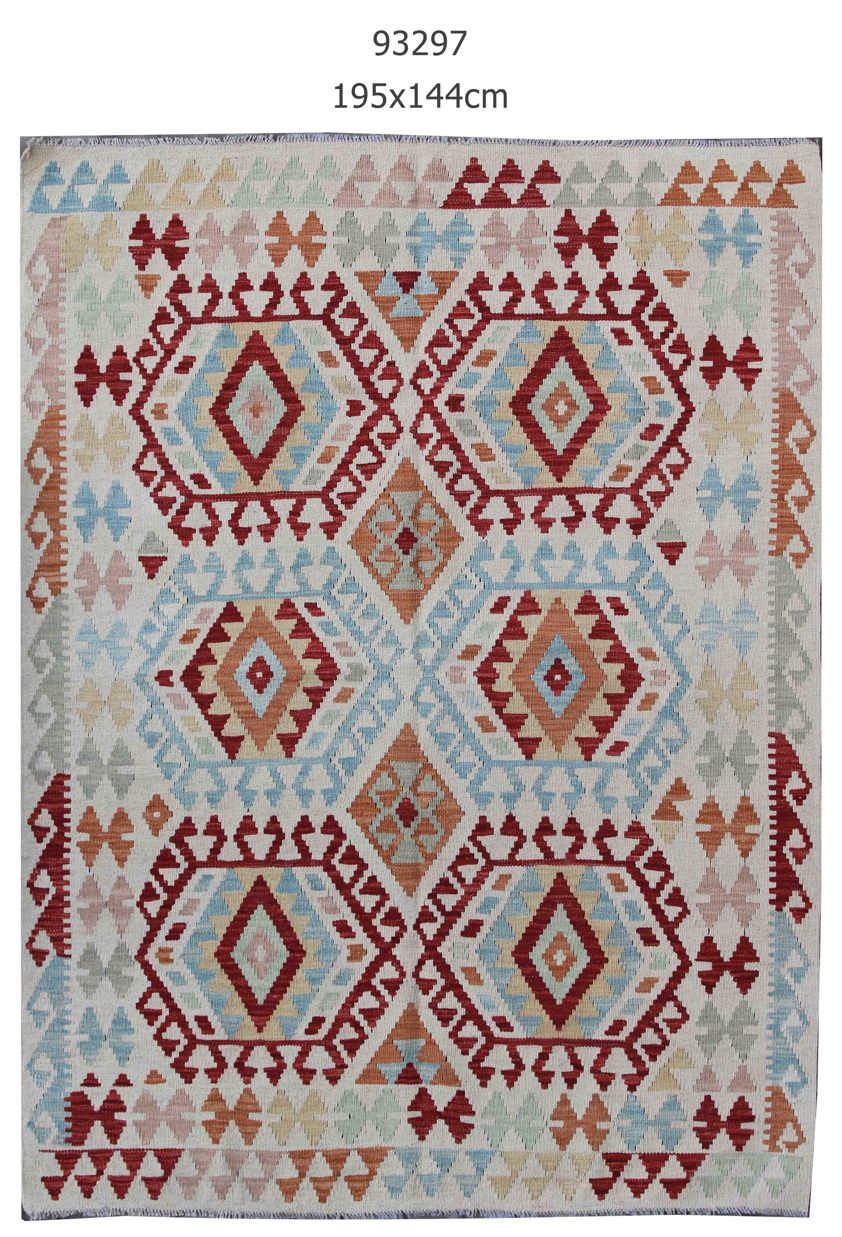
Four large burgundy-edged hexagons form a balanced arrangement across the pale field of this Afghan kilim rug. Their centres contain nested diamonds in blue, cream and muted warm shades. Smaller lozenges occupy the central gaps and side spaces, creating links between the principal forms. Narrow end bands repeat little angular units, giving the open composition a clear finish. The pale background makes the stronger burgundy outlines particularly legible. Blue adds a cooler layer within each centre, while smaller cream shapes soften the transitions. Fine horizontal shifts of tone are visible through the flat surface.
The larger hexagons provide order, but the changing colours and smaller scattered motifs prevent the design from feeling rigid. The overall effect is light, with colour concentrated in a few distinct geometric areas. The pattern of a kilim is formed by coloured wefts interlacing with warp threads. This flatwoven structure is different from knotted pile construction. Stepped outlines and nested angular forms are closely suited to the process, allowing large geometric units to carry several layers of detail.
Afghan kilims are part of a varied furnishing tradition with many approaches to repetition and framing. This rug would suit pale wood, neutral seating and understated walls. Burgundy accessories could pick up the strongest lines, while soft blue details would offer a quieter connection. Its four-part arrangement would remain effective around a small table if the main centres stay visible. The light background could also make it a gentle patterned accent in a bedroom with simple fabrics.