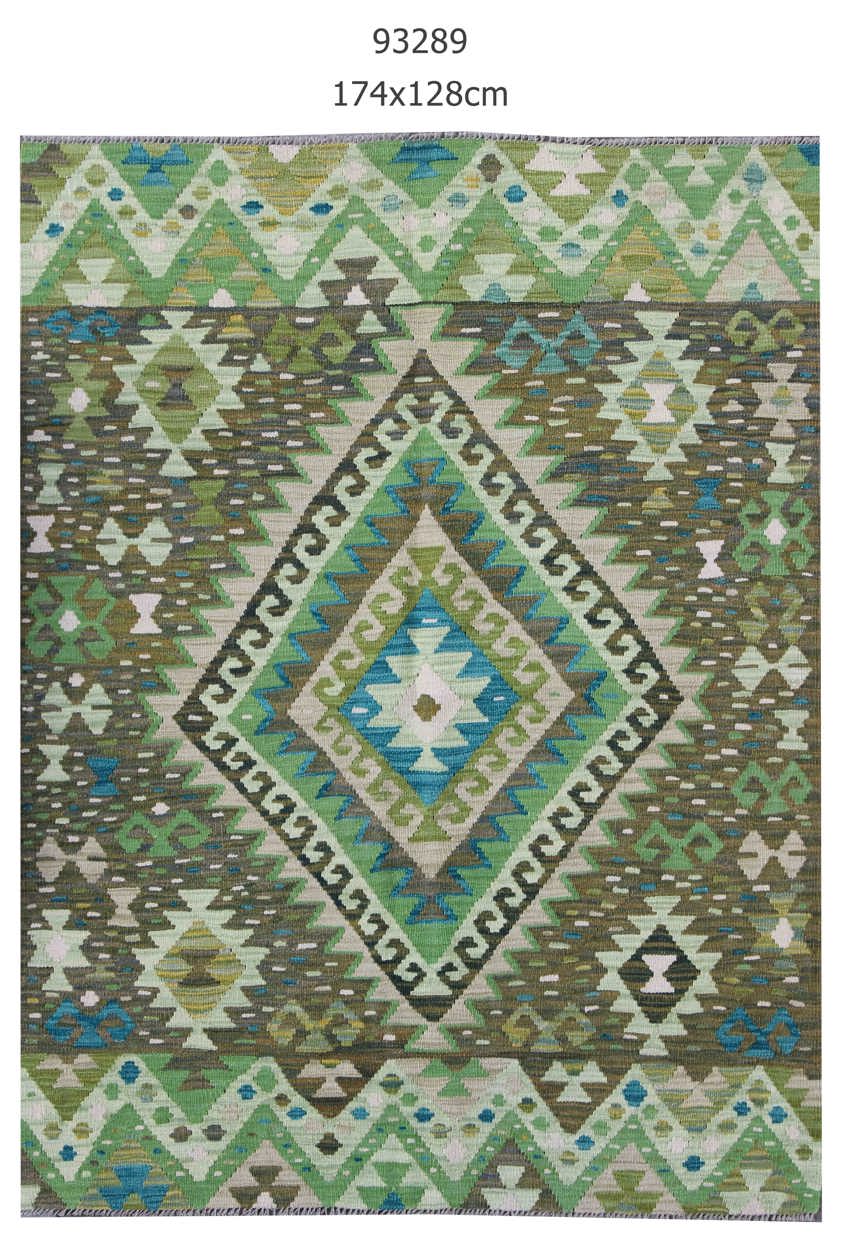
A large central diamond gives this Afghan kilim rug a clear focus within its olive-green field. Blue, cream and muted yellow outlines build around a smaller geometric centre, with hooked details adding movement to the edges. Pale angular motifs are scattered through the surrounding ground. At the ends, broader zigzag bands create a lighter frame and repeat the field's blue-green palette. The background is richly varied in tone. Fine horizontal shifts of olive, green and darker shades create visual depth beneath the geometric drawing. Cream details remain crisp against it, while blue accents provide cooler contrast. The central diamond is substantial, but smaller motifs keep the surrounding areas active.
This balance gives the rug a strong centre without leaving its edges visually empty. Kilim is a flatwoven textile form, made through the interlacing of warp threads and coloured wefts. It differs from a carpet constructed with knotted pile. Stepped boundaries, hooked outlines and repeated angular forms are closely compatible with flatweaving. Afghanistan's furnishing traditions include many such geometric textiles, with individual designs varying in the prominence of central medallions and surrounding repeats.
This rug would sit naturally beside timber furniture, neutral upholstery and muted green walls. A blue ceramic or cushion could pick up the cooler outlining. Its central diamond would be most effective where it remains partly visible, perhaps beside a seating group or beneath an open table. The lighter end bands would help connect the darker field to a pale surrounding floor.