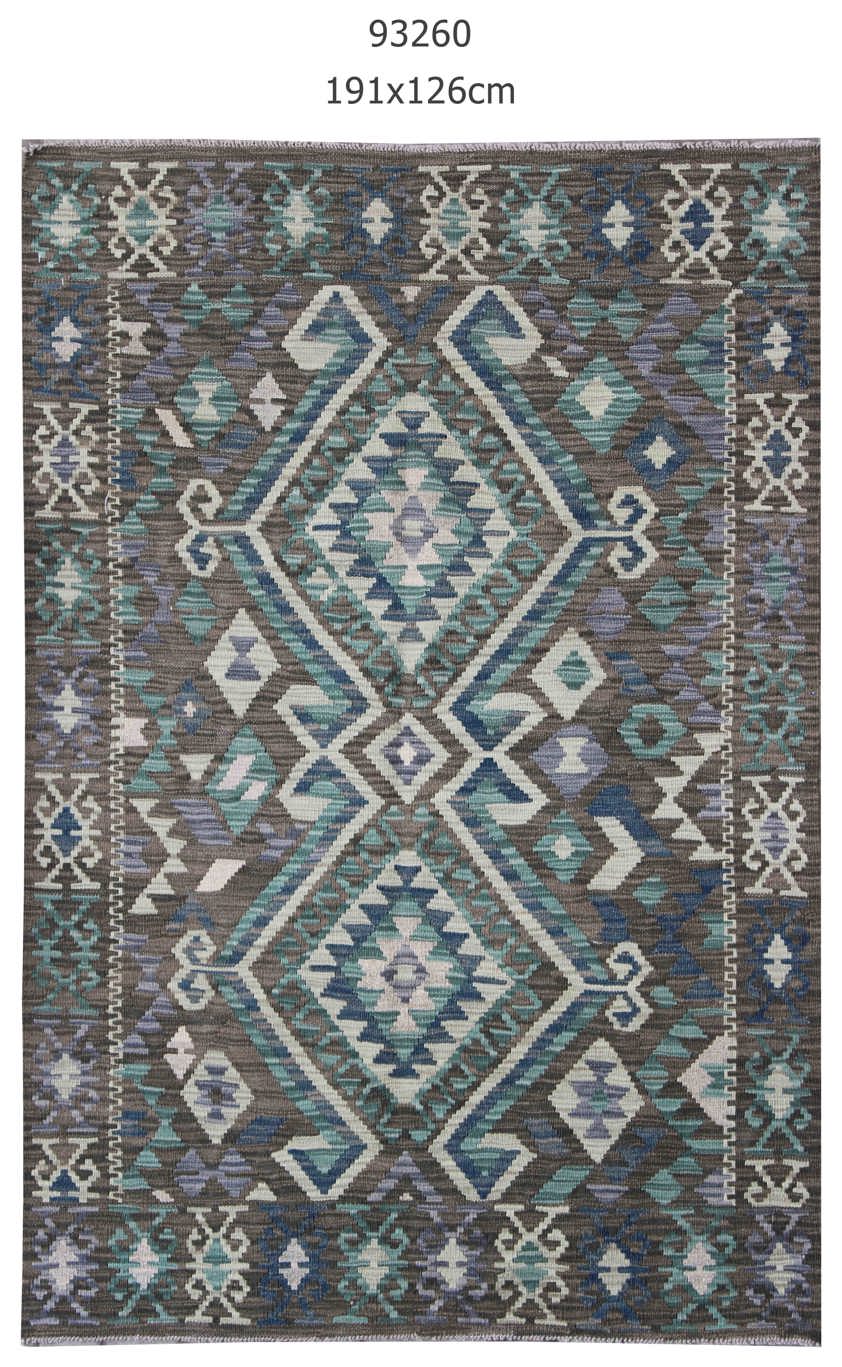
Two linked diamonds form a pale framework against the dark blue and charcoal field of this Afghan kilim rug. Their centres contain nested shapes in cream, turquoise and muted green, with smaller lozenges distributed around them. Hooked lines extend from the larger outlines, adding movement to the angular composition. A narrow patterned border repeats pale geometric motifs along the sides and ends. The background is finely varied, with horizontal shifts of blue, grey and olive visible across the flat surface. These changes soften the contrast with the cream drawing. The central diamonds remain the clearest features, but smaller stepped forms provide interest throughout the field.
The border has a denser rhythm, creating a distinct edge around the more expansive shapes inside. Kilim refers to a flatwoven textile, made as coloured wefts interlace with the warp. It is different in structure from a carpet with a raised knotted pile. Stepped diagonals, hooked boundaries and repeated angular units are particularly compatible with flatweaving. Afghan furnishings include many such geometric textiles, with varied approaches to the balance between central motifs, surrounding field and outer frame.
This rug would bring pattern to an interior with restrained colours. Pale upholstery could echo the outlines, while dark timber would connect with the background. Turquoise or muted green details elsewhere would pick up the quieter accents. A light, open table would preserve the linked central arrangement, allowing the larger diamonds and their smaller surrounding motifs to remain visible within a furnished space.