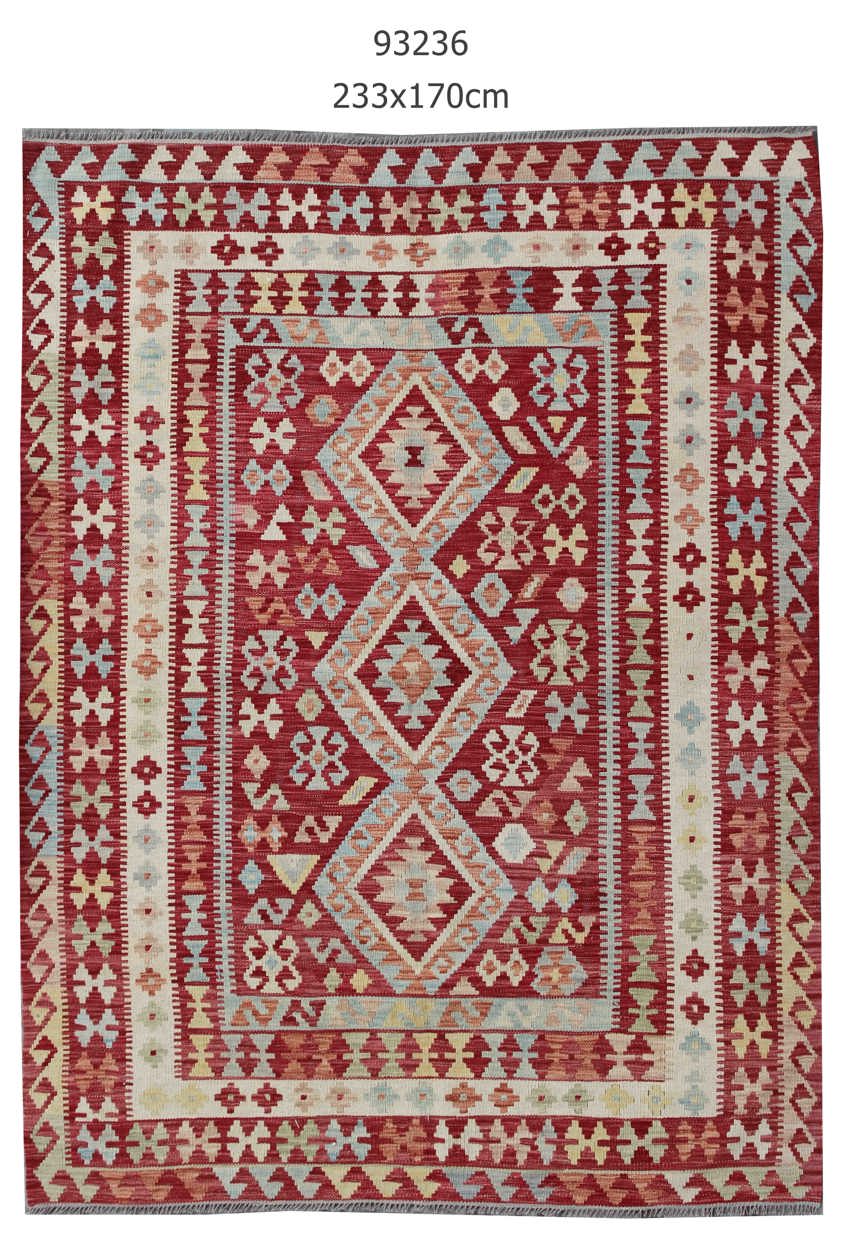
Three pale-edged diamond centres run through the red field of this Afghan kilim rug. Their stepped outlines contain smaller geometric forms, with blue, cream and muted warm details changing from one centre to the next. Around them, small angular motifs fill the remaining ground. Several border bands build a layered frame, alternating light areas with stronger red pattern. The composition has a clear hierarchy. Large central diamonds establish the main sequence, while the closer border details provide a quicker rhythm around the edges.
Cream outlines make the pattern readable against the red, and small colour changes within the field add depth. Fine horizontal variations are visible across the flat surface, softening the more precise stepped geometry and giving the background a subtly shaded appearance. Flatweaving creates a kilim by interlacing coloured wefts with warp threads. The design is formed as part of that structure, without the knotted pile of other carpet types. Stepped diagonals and repeated angular motifs are closely compatible with the method.
In Afghanistan, such flatwoven furnishings belong to a varied textile culture, with many different relationships between central field and enclosing border. This rug would sit well with cream seating, natural timber and understated walls. The broad frame helps define a smaller furniture group, while the central sequence provides direction. An open-legged table would leave more of the diamonds visible. Blue details in a cushion or ceramic piece could connect to the cooler accents and balance the warmth of the red.