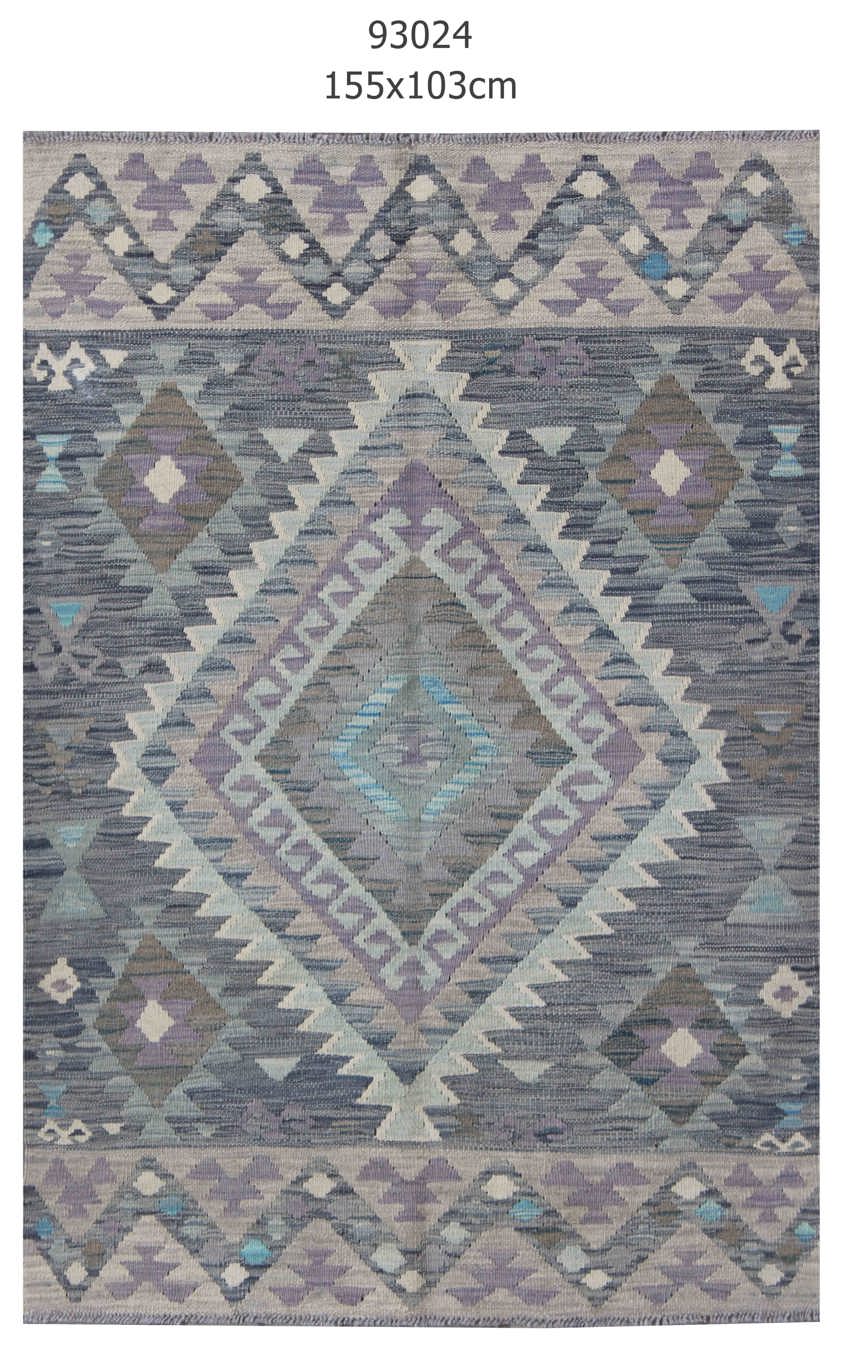
A single large diamond gives this Afghan kilim rug a clear focal point. Grey, cream and lavender bands build outward from its small centre, creating a broad nested form that occupies most of the field. Smaller lozenges appear at the sides, while zigzag bands finish the ends. The palette remains restrained, with pale blue details introducing a cooler note among the grey and purple tones. Stepped edges give the principal diamond a rhythmic contour, echoed by the smaller surrounding motifs. Fine horizontal changes are visible through the field, softening the contrast between neighbouring colours and adding a gently striated appearance.
Afghan geometric textiles often expand a basic lozenge into a substantial medallion, using nested outlines to establish scale and focus. Related forms also occur on domestic bags and other woven furnishings. In kilim weaving, decoration is integrated into flat fabric rather than a raised knotted pile, placing particular emphasis on the arrangement of coloured shapes.
This example uses that directness with a compact palette and a strongly centred layout. At 155 by 103 cm, this rug could define a small space beside a bed or armchair. Grey upholstery and pale walls would connect with the field, while a lavender cushion could draw out the quieter colouring. A position where the centre remains visible would make the most of the large diamond, whose broad outlines give the rug more visual presence than its modest dimensions might suggest.