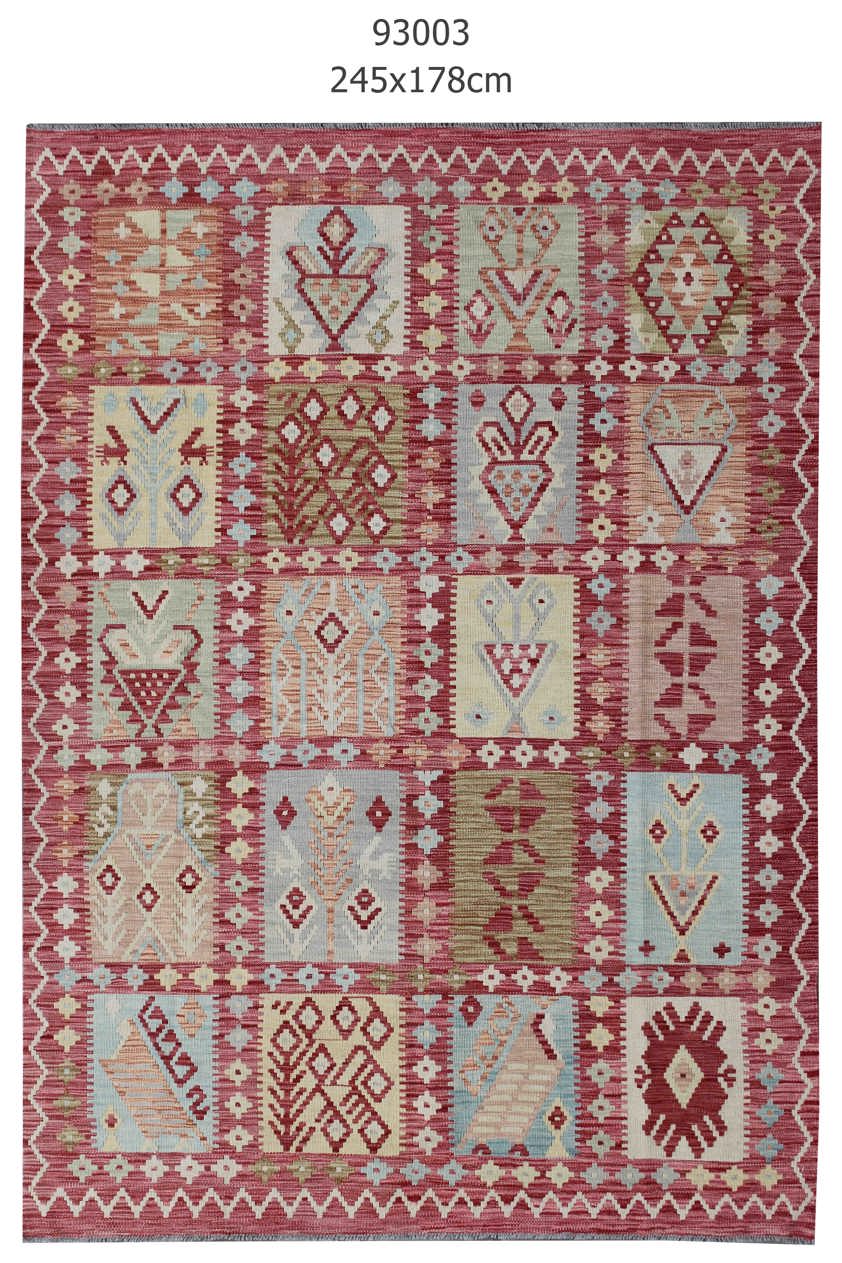
Muted red, cream and touches of pale blue give this Afghan kilim rug a softened palette, while its panelled composition remains clearly defined. Twenty compartments contain varied angular motifs, including branching stems, nested diamonds and forked geometric forms. Small pale devices run along the red dividing bands, making the framework decorative in its own right. The drawings differ from panel to panel, encouraging the eye to explore the whole rug rather than settle on one centre. A fine zigzag edge surrounds the grid, and the colours show gentle horizontal changes within individual compartments.
Those tonal shifts bring visual texture to the flat surface and make the regular arrangement feel less rigid. Panel-based decoration has a practical place within geometric textile design: it allows several motifs to share a single ordered field. Afghan furnishings have used a wide range of such geometric and stylised forms across rugs and other domestic textiles. In a kilim, the decoration is integrated into the woven fabric, giving the contrasting silhouettes a direct graphic clarity.
At 245 by 178 cm, this rug would bring detailed pattern to a room with simple furniture. Cream upholstery could connect with the pale panels, while red-brown wood would complement the warmer divisions. The evenly spread compartments remain interesting around the edges of a coffee table or beneath open-legged seating. A restrained selection of accessories would allow the individual drawings, rather than a large central medallion, to set the room's decorative character.