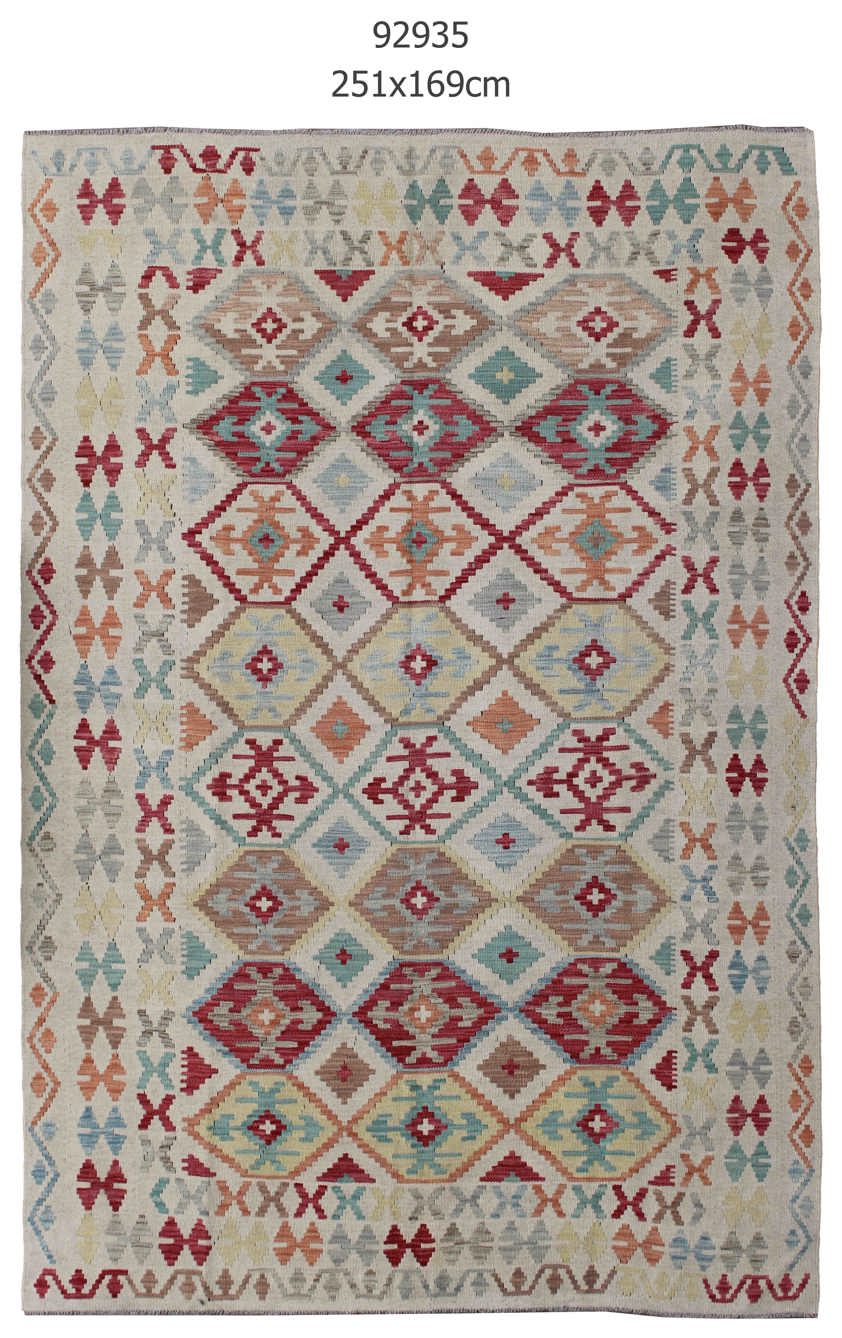
Horizontal bands give this Afghan kilim rug its distinctive organisation. Red, teal, ochre and pale blue diamonds line up across the field, with smaller centres and stepped outlines creating detail within each band. Some rows are strongly coloured; others are pale and quieter, producing a gentle alternation of emphasis. The enclosing frame uses little paired devices in a much smaller scale. Their loose spacing leaves plenty of pale ground visible, providing an interval between the central pattern and the edge. This contrast makes the horizontal structure easier to appreciate. The red rows catch attention first, while the turquoise and ochre sections add variety as the eye moves through the design.
In flatwoven textiles, rows offer a simple organising principle that can support considerable decorative complexity. Kilims develop their pattern within the woven fabric, without a knotted pile. Afghan geometric designs use repeated shapes in many configurations, and variations of colour or internal detail can distinguish one band from another while maintaining continuity across the whole surface.
This rug could work particularly well with a wide piece of furniture, where its horizontal rhythm would offer a useful counterpoint to vertical chair and table legs. Pale timber and linen would keep the setting light, while burgundy or green accessories could refer to individual rows. The open border makes it easy to see where the field ends, giving the furniture group a clear but gently coloured frame on the floor.