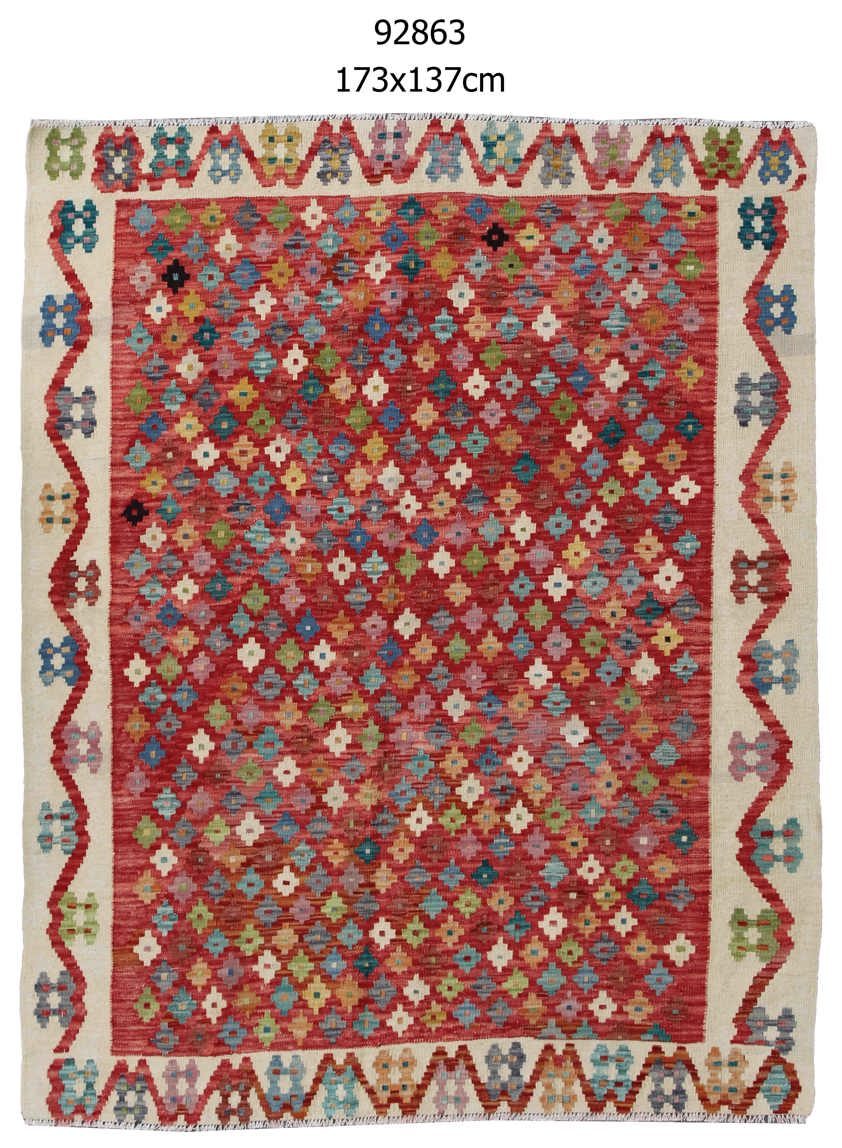
Small multicoloured geometric flowers cover the red field of this traditional Afghan kilim rug, creating a close, mosaic-like pattern. Cream, blue, green, ochre and darker accents alternate across the surface, with little gaps of red holding the many motifs together. A pale border provides a clear contrast, carrying larger angular forms along the sides and zigzag sequences at the ends. Unlike a design organised around one medallion, this rug distributes its interest evenly. The eye moves between clusters of small shapes, finding changes in colour rather than a single central focal point.
The border's larger motifs offer a useful pause after the tightly worked field. Its pale ground also keeps the red centre visually distinct from the floor around it. The repeated geometric vocabulary of Afghan kilims allows small motifs to build complex surfaces through simple shifts of position and colour. Domestic textiles have long used this balance of repetition and variation. In this example, the density of the central pattern contrasts with the more spacious border, showing two different ways of organising related angular forms within one rug.
At 173 by 137 cm, it could bring warmth and intricate detail to a compact sitting area or the side of a bed. Plain cream fabrics would relate to the frame, while dark timber could ground the brighter colours. Leaving the border visible around furniture would preserve the pleasing transition from dense red pattern to the lighter, more open edge.