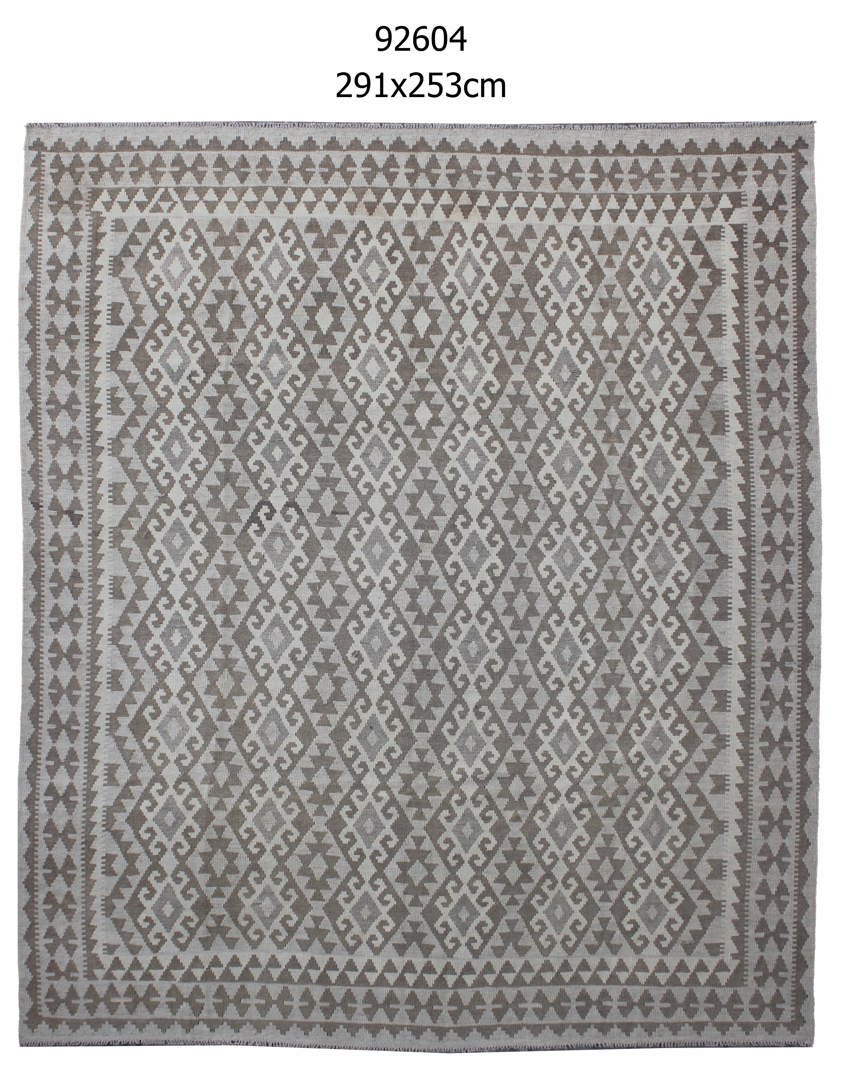
A dense grid of hooked angular forms gives this Afghan kilim rug a distinctive graphic surface. Dark grey motifs repeat across a pale ground in close diagonal relationships, creating an almost continuous network. The shapes remain small in relation to the overall rug, so the design reads as fine pattern from a distance and resolves into individual hooked units when viewed more closely. The border is clearly defined by several rows of little triangles and angular marks. These change the direction and scale of the ornament while retaining the same grey-and-cream palette.
At 291 × 253 cm, the rug has a broad, substantial format, making the regularity of the central repeat particularly effective. Its visual interest is evenly distributed rather than concentrated in one medallion. Repeated geometry is an important organising principle in kilim furnishing design. Afghan textiles participate in the wider flatwoven tradition, where a limited motif family can create considerable complexity across a large surface. Here the close spacing of the hooked forms establishes the field, while the enclosing triangular bands give that dense pattern a clear boundary.
This rug could support a generous seating arrangement in plain upholstery. Cream furniture would emphasise the darker drawing, while grey or black accents could strengthen its graphic character. Warm timber would add a useful contrast to the restrained colours. Because the pattern continues throughout, a central table would still leave ample detail visible around the rest of the room.